Showing posts with label PBT Techniques. Show all posts

Thursday, October 6, 2022

Updates to PBT Questions cont.


Like in last week's post, here you'll find links to important PBT posts in which I've added new books! You'll see a sampling of some of those added books in the photos here. Last time, I gave you links to the Introduction to the 5 PBT questions and the first two PBT Questions. Here are links to the last three PBT Questions. You'll find dozens of books with these updates! 


Thursday, September 29, 2022

Updates to PBT Questions


For today’s PBT post and my next, I have gone back to 6 of my best posts and added new books! A sampling of some of those books I've added are in the photos here. I’ve given you links to the first 3 posts today. 


Next week look for links to those last 3 questions. This series is at the heart of what I do here at PBT. There are many God Books here at PBT, but all the books in this series are secular. That's the point of the series. These 5 questions help you find the sacred in a secular book. Let me teach you my short cuts for finding the theological potential of secular books.

Sunday, June 19, 2022

PBT Techniques #11: Object Play

The PBT Techniques series explores unusual ways to use picture books in ministry. If you want to see more of these PBT posts, there are quick links at the end of the post. Also, I mention the work of 2 other authors you should know about: Leanne Hadley and Diane Alber!

Today’s book is excellent, but for a group read aloud it is a bit wordy. Also, the illustration details are many. Some wordplay and geological puns will be beyond the understanding of most elementary-aged children. Instead of reading it aloud, use this book as inspiration for a story you tell with easily found objects.
Whenever a picture book inspires you to tell a story, always say the author's name. When the illustrations are pivotal to the story, as in this book, give the illustrator credit as well. These are not just good ideas; they are ethical practices!
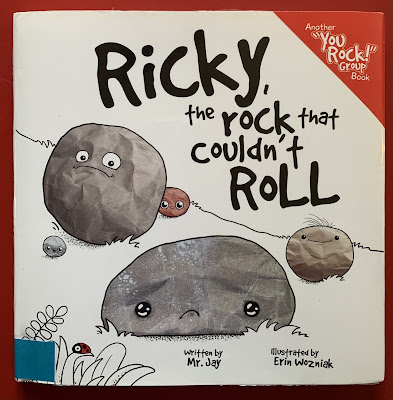
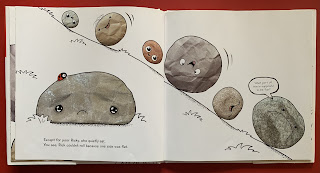
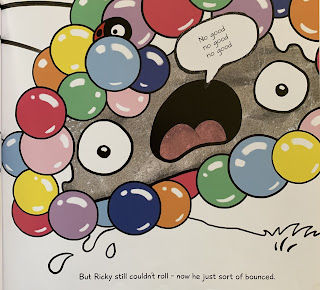
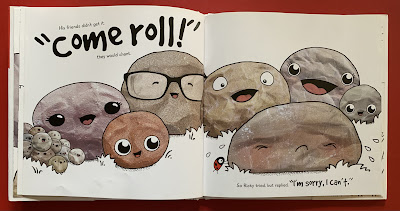
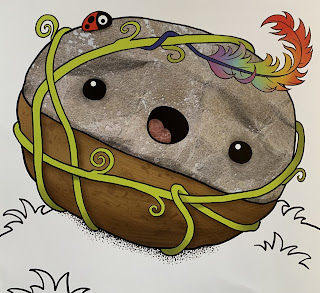
Picture Book: Ricky, the Rock That Couldn’t Roll

Author: Mr. Jay (aka Jason Miletsky)

Illustrator: Erin Wozniak

Summary: This story is about a group of rocks and pebbles who are great friends. They repeatedly race to the top of a hill to enjoy the view and then joyfully roll down, in great communion with the ritual in nature and joy of each other's company

Many of the rocks have clever names, and their play is silly and creative. However, Ricky, who is a bystander of the group, was not able to roll. Watching was all he could do because of his flat bottom. His friends, like the friends in Mark 2 who creatively drop a peer through the roof to Jesus, are determined to help. Unlike the biblical story,  many of the rocks' initial ideas are disastrous!

When it starts to rain, Ricky's friends have an idea. They carry Ricky down to the mud and help him make himself round. Finally, Ricky is able to roll and fully enjoy the play and his loving friends. Now they are a better community because Ricky is able to participate!
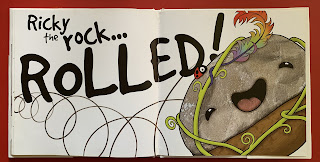
Hanna’s Comments: If only all Christian communities were so determined to accommodate and include! This story has much potential for discussion and application to loving practices at church and at a school! For the object play, simply collect a variety of rocks and pebbles. Then tell the story your own way. You will need to simplify the story a lot! You'll likely want to use brown modelling clay or dough for mud. Don't feel like you must provide a prop for the hill. Be imaginative with your movements. The children will get it. If you want a hill, use a pillow or cushion and a green pillow case or thin towel. You might want to gather more flat rocks so that all your children can hold and re-create their own versions of Ricky. 

If you tend to think metaphorically, as I do, you'll realize that this story has a great deal of depth if we consider mud as a metaphor for difficulty, struggle, or even the terrible hardships that may lead to resilience. It can even be a metaphor for sin which could lead to ironic connections to baptism. This simple story would be an excellent children's sermon because it has that potential for depth and application to all ages!

Stones, like picture books, have great potential for ministry! My friend Leanne Hadley, an ordained pastor, has designed a beautiful tool for helping children be open and vulnerable in their verbal sharing, especially in times of stress, grief, and crisis. Check out all her work HERE.    OR 

her short YouTube video demonstrating this tool: Holy Listening Stones  

Additionally, there are several other great picture books about stones by Diane Alber. She explores important social-emotional skills in these. She even has some books about scribbles - another easy possibility for object play.  Check them out as well HERE.

Original Publisher: Lyric & Stone, 2018

Age Appropriateness: 7 and up

Formats other than Book: None at present

Scripture Connections: Friends drop a paralyzed man through the roof to be healed by Jesus (Mark 2: 1-12); Jesus uses mud to heal a blind man. (John 9:1-7) 

Connections to The Revised Common Lectionary: In my Trinity Treasures curriculum, I have based a preschool Sunday school lesson on this relatable Bible story for Year B, on the 7th Sunday of Epiphany when Mark 2:1-12 is listed.  

PBT Applications: As described above, to better keep children's attention, tell this story using objects. Simplify the story and tie it to Mark 2 by connecting the actions and motivations of the friends in both stories. I once heard a sermon about those friends. The speaker argued they must have been adolescents because of their audacity and determination to push through a boundary! I always think of those biblical characters in that way. After telling the story, you may want to use 5 stones to tell that Bible story. OR Have your children act it out. Unless you're telling the story in a children's sermon, consider ending the lesson with some dancing to "rock & roll!"

Links to other posts about PBT Techniques: 


#4 Using the Whole Story

#5 Using Poetry in Ministry


If you are interested in learning more about my Trinity Treasures, a scripture based preschool Sunday school curriculum that features picture books & children’s Bibles, contact me at hannaschock@bellsouth.netRight now, free lessons are emailed if you agree to fill out the monthly feedback form.


Monday, January 28, 2019

PBT Techniques #10 – Shallow to Deep

If you'd like to read more posts in this series, simply type "Techniques" in the search box to the right. 
You’ve read my encouragement to use picture books for adult small groups. In case any of you have doubts about this practice, I’d like to tell you about 2 recent lessons with my Sunday school class, a class that can quickly go from shallow silly fun to deep meaningful conversation. 

Recently, a much-loved member of our class died of early-onset Alzheimer’s. I invited the class to explore ideas of loss and being lost via 2 simple picture books. At first glance, these books might be considered shallow stories for children only, but I beg to differ. There is much wisdom in them. They allowed for gentle tiptoeing into deep waters of meaning and opportunities for serious reflection.


In the first lesson, I read Mo Willems' Knuffle BunnyHere’s that PBT post. It comically tells the story of a pre-verbal child leaving her comfort object at the laundry mat. Once read, I invited the class to write a scattering of losses on a page. Since language is an important aspect of this story, I asked them to write words describing their core feelings about their losses. I reminded them of The Pascal Mystery (life, then death, then resurrection) which is a key aspect of Christ's life and teaching. Then we considered how often Jesus dealt with loss. A profound moment occurred when I asked them to imagine a world with no loss. They could not.

For the next lesson, I took these thoughts a step further. First I shared a few Richard Rohr quotes about transformation being tied up with loss and suffering. Then I introduced Walter Brueggemann's cyclical Rhythm of Life (Orientation, Disruption, Disorientation, New Orientation). Before reading Baby Bear by Kadir Nelson, I asked them to listen for the particular wisdom from the 7 animals that the cub encounters. After the reading, it was easy to find biblical connections to some of the animals' suggestions (Sit still and try to listen. Trust yourself. Don't be afraid. Look up. You are not alone.) Then we shared some stories of being lost. Here's my PBT post about Baby Bear. 

I think both lessons were meaningful, thought-provoking, and enjoyable because of the great literary and visual artistry of  Willems and Nelson. Never let it be said that picture books are just for children!

Monday, November 13, 2017

PBT Techniques #9 - DANCE!

Sometimes we make creating a lesson for children harder than it has to be. Children express God’s joy with their bodies more readily than we adults. Swallow your pride and plan to dance at the end of a lesson. Choose a joyful song (video or audio). Once the PBT book is read and all the necessary words of the lesson are spoken, invite the children to stand with you and clear the space. Start the music and DANCE! Show them how you can dance joyfully to The Lord! Psalm 149 and 150 mention dancing for The Lord with tambourines so consider adding a little instrumentation. What fun! It might become a ritual that keeps your kids coming back for more.

Here’s a former PBT post of a great book that’s perfect for this kind of joyful lesson wrap-up. You can choose to use Bob Marley’s song, but I like the video I’ve linked for you. It’s great fun with a similar theme and lyrics that make more sense to children than Marley’s song:
Bring the Beat [video]
Picture Book: One Love:                                                                                              Based on the Song by Bob Marley
Adapted by: Cedella Marley
Illustrator: Vanessa Brantley-Newton
Summary: Bob Marley’s oldest daughter offers this adaptation of one of her father’s most beloved songs. Though the words of the book do not conform to the lyrics of the Bob Marley recording, the simpler text & fun illustrations offer a meaningful message of joy and hope as a young girl convinces a group in her community to transform it into a more beautiful space.
Hanna’s Comments: Singing along with the book may not be possible, but you can read the book, talk about how your community might be transformed, and then everyone can dance to the reggae tune. The original lyrics have some Christian references, but they are hard to understand and will likely be ignored by children. A skilled musician might be able to adapt the book’s text to a tune comparable to the original. This book is all about making connections with one another and nature so it’s a perfect PBT book.
Original Date & Publication: Chronicle Books, 2011
Age and Grade Appropriateness: 3 and up, Pre and up     
Formats other than Book: Tablet
Scripture Connections: Love is patient and kind (1st Corinthians 13: 4-8); Let all you do be done in love. (1 Corinthians 16:14); Put on love which binds everything together in perfect harmony. (Colossians 3:14)
Idea(s) for Application: Read this book as part of a children’s celebration after they take part in beautification activities or simply doing some cleaning and picking up litter on the campus of your faith family.

Friday, July 21, 2017

PBT Techniques #8 - Adapt for a Play

Now and then I read a book with illustrations that I think do the book a disservice. Below I’m featuring one of those books and giving you ideas about using this book’s great content in a different way.
Picture Book: The Want Monsters: And How They                                          Stopped Ruling My World
Author & Illustrator: Chelo Manchego 
Summary: Want Monsters just want to make people happy. The little guy in the illustration below explains that his Want Monster, Oskar, motivates him do GOOD things, but lately Oskar has gone a little crazy! 
He wants four cupcakes, not one. The narrator gives in 
and gets sick which leads to a lot of time in the bathroom! Oskar has grown some extra thumbs. He spends too much time playing games in front of a screen. 
Now the little guy's high fives hurt! 
 The desire for attention gives Oskar a crown, but
when the boy gets too much attention, no one else wants to be around him! 
Oscar gives the boy a flower with a caterpillar in it; the boy asks the caterpillar if he too has a Want Monster. 
The caterpillar explains that eating is already all he wants to do, 
but that is the way of caterpillars so they can become butterflies. 
He suggests that the boy tell Oskar "no." 
 
That won't always work so just let "Oskar be Oskar."  
When our narrator had ice cream the next day, Oskar insisted on the whole carton, but the boy stood up to him. 
Oskar tantrumed, the boy ignored, and both forgot about the want of ice cream. When the best video game ever, "Zombies Ate My Teachers" came out, both were happy. 
But when "Zombies Ate My Teachers TWO" came out just 10 days later, Oskar insisted that another trip to the video store was in order.
The boy explained that you can have too much of a video game. Besides, new games come out all the time and don't keep them happy for very long. 
Oskar tantrumed, but both eventually forgot about that particular want.  
When they saw a girl win a big contest on TV, Oskar got jealous and wanted his boy to win a contest on TV, but the boy responded, "We can't have everything we want." Oskar tantrumed. Eventually, Oskar forgot. Eventually, Oskar got much smaller. 
Renamed, Oskarcito, he is being trained to want things that make everyone feel good, like kindness and sharing. 
Everyone wants those and feels good afterwards!
Hanna’s Comments: The ideas in this book offer great potential for meaningful conversation with elementary-aged children about greed, gluttony, anger, and difficult relationships. Convert this story into a simple play that your kids act out. They will relate and be able to easily act out these emotions and respond to these situations. In fact, have your children help you create the play. You might want to have some of your girls help write a character who tells about how girls struggle with Want Monsters. Expand it even further by including some of their parents Want Monsters too! Be sure to cast kids for human and Want Monster characters. The best learning happens when we are synthesizing information. That means we take various aspects of what we have learned, combine, and make something new. Writing and producing a play about this book might be a great tool for making a difference in these issues that hit at the heart of modern family dynamics.
Original Publisher & Date: Shambhala, 2016
Age & Grade Appropriateness: 4 and up, Pre and up
Formats other than Book: None at present
Scripture Connections: They tested God in their heart by demanding the food they craved. (Psalm 78:18); A greedy man stirs up strife. (Proverbs 28:25); Take care and be on your guard for covetousness, for one’s life does not consist in the abundance of possessions. (Luke 12:15); You are God’s holy temple. (1 Corinthians 3:16-17); Their god is their belly…with their minds set on earthly things (Philippians 3:19); Keep your life free from love of money and be content with what you have (Hebrews 13:5); Those who desire to be rich fall into temptation…The love of money is the root of all kinds of evil. (1 Timothy 6:9-10); The desires of the flesh and the desires of the eyes and pride in posessions – is not from God but is from the world. (1 John 2:16)
Idea(s) for Application: Use this book as a basis for a play that your children act out. Connect the issues in this book to some of the many scripture verses about greed and gluttony.  

Friday, July 7, 2017

PBT Techniques #7 - Flip-Flopping

One of the benefits of PBT is bringing high-quality secular stories to audiences of faith. Encouraging connections between that story and scripture boosts faithful responses for several reasons. Check out my Picture Books in Ministry tab for more about this. There is so much below the surface of these secular picture books!
Children's literature is getting better and better! Some stories are so good, you want your audience to explore them thoroughly, like the PBT book I'm featuring today. This new picture book, has so much to offer I encourage you to do what I call The PBT Flip-Flop, which involves finding the connections in opposite aspects of the story. I explain more in my comments below. It's so simple to do!
Picture Book: Hattie & Hudson
Author & Illustrator: Chris Van Dusen
Summary: Hattie lives near a beautiful lake. She has an nature exploration ritual every morning.
On this particular morning, Hattie sings a sort of invitation song in her canoe. A huge creature, who usually stays hidden deep within the lake, is lured by Hattie’s lovely song. He decides to breach the surface, something he has not done for a very long time, despite being lonely. 
 
When the creature surfaces, Hattie is intrigued so she keeps singing. 
After looking in the creature’s eyes, Hattie knows there is no reason to fear. The creature even begins to harmonize with her!
However, the others on the lake soon see the creature and are terrified. The creature disappears into the waters. 
Both Hattie & the creature wonder if they'll see each other again. That evening Hattie decides to venture out and see. 
They do meet again. Hattie isn't afraid of the two eyes below the surface
or the creature's head when it emerges. She names her new friend Hudson. 
They play together all night and plan to meet again the next evening. 
The next day a meeting at The Town Hall is all about "getting rid of ...the Deadly Beast." Hattie tries to speak up, but there's no room for her voice. 
When Hattie and Hudson meet again, Hattie explains the adults' plan. Hudson surprises her with a bump of the canoe and a smile, then another bump and smile. Hattie soon understands. 
Next morning as her neighbors prepare, Hattie paddles to the center of the lake and waits for Hudson. 
 Hudson gently overturns Hattie's canoe. 
Then Hattie's acting begins. She makes sure her screams of terror are heard by the neighbors. As expected, they jump in their boats to rescue her. 
 
Just as they get close, Hudson to the rescue! 
The neighbors all watch in amazement as Hudson lifts Hattie above the water. 
Hudson gently swims Hattie to the pier and places her there. 
Next, Hattie holds a meeting of her own. She introduces Hudson, declares him to be safe, and assures everyone that once they get to know him, he will be their friend too. A boy approaches, and eventually others befriend Hudson. 
Once Hudson is fully integrated into the community, people from far away come to meet and play with him, the "famous friendly monster."  
But at night, it is just Hattie and Hudson growing and playing together.
Hanna’s Comments: If you are inclined create or piggyback a tune for Hattie’s song and sing it while reading. A musical friend of mine suggested trying the tune to "Do Your Ears Hang Low." Singing will enhance this story experience. The PBT Flip-Flop method is to read the story and then have 2 very different (even opposite) conversations. With this book, I encourage you to ask your audience the 2 questions below. Ask the second question only after the first has been discussed.
How is God (or Jesus) like Hattie?
How is God (or Jesus) like Hudson?
Another way you can use this book is to encourage connections to the gospel story in which Jesus heals the man born blind who then must defend Jesus to the Pharisees. Simply ask your audience to find any connections between that gospel story and the picture book. The stories don't have to be parallel. They just have to have some connections. Another Bible story to consider is Philip and the Eunuch. Notice the holy ideas that are here such as Hattie's contemplative ritual each morning. There's an aspect of worship in her ritual. Consider Hudson being lured by Hattie's song. That's like previenent grace. There's a lot of holy risk-taking and justice seeking for the stranger in this story. Talk about those! 
Original Publisher & Date: Candlewick Press, 2017
Age & Grade Appropriateness: 4 and up, Pre and up
Formats other than Book: None at present
Scripture Connections: Do not be conformed to this world... (Romans 12:2); Scriptures about the nature of God such God being viewed as a shield for all who need refuge (Psalm 18:30) Or the nature of Jesus such as when he heals the man born blind (John 9:1-34) or Philip, Jesus' disciple, welcoming a eunuch into Christianity (Acts 8:26-40); verses about welcoming the stranger such as when Jesus heals the Bent-Over Woman (Luke 13:10-16) or Jesus visiting Zacchaeus (Luke 19:1-10) Or scriptures about wisdom or discernment when faced with a problem
Idea(s) for Application: Read this book to a group of tweens or older and ask them to find connections via The PBT Flip-Flop method as described above in my comments.