Showing posts with label social justice. Show all posts

Friday, May 24, 2019

“What Am I Doing to Make Malala Proud?”

Today my daughter Julianna graduates from college. You'll see below in the PBT post from 2015 that I reference how Malala Yousafzai has inspired her. Julianna has had a desire to teach urban children for a very long time. In a few weeks, she leaves her Alabama home to serve with Teach for America in Cleveland, OH. Posting this again serves as a little tribute to Julianna's passion and courage. Also, consider it a bit of gratitude for all who inspire our young people who are determined to make this world better for those living on the margins. More books about Malala have been published since this post. Check them out and choose your favorite to inspire the young people in your faith family.
The title of this post is the question my teenage daughter, Julianna, asked herself the spring before her senior year in high school. Her answer was to pay her way on a mission trip with a group of our church’s adults to teach English to Panamanian children. I think Malala would have been pleased!

When I first heard my daughter’s question, I thought of the WWJD? (What Would Jesus Do?) bracelets that were a fad with teens here in the states for a while. That fad is long gone; those teens have grown up. Ironically, my Christian daughter seems to have found a meaningful role-model in a Pakistani, Muslim girl near her own age. I hope Malala survives the continued threats to her life and lives a long life inspiring my daughter and others.

Malala Yousafzai, advocate for the education of Muslim girls, victim of an assassination attempt, and the youngest Nobel Peace Prize winner is only a few months younger than Julianna. When the already famous and outspoken 16-year-old Malala was called out and shot on her school bus by the Taliban in Pakistan, she became more famous. Julianna began to read articles about Malala’s advocacy, recovery, and amazing courage to continue speaking publicly for the rights of all girls to be educated. Like Malala, Julianna has a passion for education. She plans to be a teacher and has a heart for urban children. She was quick to read I am Malala, Yousafzai’s best-selling memoir, and we all enjoyed seeing Malala tease John Stewart on The Daily Show. I highly recommend the feature length film about her, He Named Me Malala.   
Above I’ve offered photos of 3 picture books about Malala Yousafzai. You’ll have no problem finding these and other picture books at your local library or on-line. Video content is easily found too. It’s important for young children and teens to have heroes, especially if the heroes are near their age. Your message can be that being a child/teen doesn’t give you an excuse for not doing justice or working for peace. Everyone can do something now.

There are other, less decorated and lesser-known teens and tweens in our world making it more just and loving. A little internet searching and some creativity on your part might lead to some very meaningful programming for the young people in your faith family. Be sure to identify the traits that your children can emulate from the heroes you offer. Point out when their passions are grounded in their faith. 

Your children and teens are going to have heroes. When the substance of their fandom can be about more than beauty, sports, or entertainment, then our world has better opportunities for God's desires. I believe Malala would be very proud of such changes. 

Friday, April 12, 2019

Is Prayer Saying Something?

Here's another brand new book that can lead to a rich discussion of prayer as well as many other theological ideas. I'm sure it will show up in my PBT Grab & Go series someday. There's lots of treasure here!
Picture Book: Say Something
Author & Illustrator: Peter H. Reynolds
Summary: This author is known for encouraging readers to creatively dream, hope, and do to bring about a better world. 
He empowers us to speak up in all sorts of verbal
 and nonverbal ways. 
Say something with your presence
or your courage.
Sometimes actions speak louder and are more lasting (and beautiful) than words. 
 Literary and 

science types are represented.
 Even a sense of fashion gets a nod.
Creative justice is a hallmark here, individual and corporate. 
And there's a warning that doubt and much patience may follow.
Every double page spread offers fertilizer for activists, prophets, futurists, and peacemakers, in other words people doing God's work for the sake of the world.
Hanna’s Comments: I see all sorts of possibilities with this gem! One of the best aspects of faith is believing that you can make a difference in the world. Hope and creativity are on every double page spread and image. Want a creative lesson on prayer? Ask before each page turn, "How can prayer be a part of this? Don't forget to talk about how The Holy Spirit empowers our messages and manner and how scripture gives us guidance and many excellent (and a few not so excellent) role models. Give your audience permission to step out in courage and say something! With God's help it just might bless the world!    
Original Publisher & Date: Orchard, 2019
Age & Grade Appropriateness: 4 and up, Pre and up
Formats other than Book: Tablet
Scripture Connections: This book can easily be connected to an individual or group of prophets in the Hebrew scriptures or the individuals who began the early church. Scriptures about hope are easily connected as are the fruit of the spirit (Galatians 5:22-23). Also, What does the Lord require of you... (Micah 6:8)
Idea(s) for Application: Let this book guide a conversation that broadens the concept of prayer during a lesson or sermon for children, youth, and/or adults.


Monday, March 20, 2017

PBT Redux Series #9 - If the World Were a Village

In this post, I continue my series in which I highlight again an excellent picture book published since 2000. I’m focusing on these more recent publications because, as I tell adults all the time, "Children's literature is getting better and better!" This book is particularly good for older elementary and youth.
Picture Book: If the World Were a Village: A Book about                                         the World’s People (2nd edition)
Author: David J. Smith
Illustrator: Shelagh Armstrong
Summary: The author imagines the world’s population as a village of 100 people, representing population characteristics & statistics in a manner that is striking and understandable. General subjects are listed in a Table of Contents to allow you to have easy access to just those statistics you want to cover. They include nationalities, ages, schooling and literacy, and electricity. For instance, if the world is a village of 100 people, 9 people would speak English, 75 people would have easy access to safe water, and 32 people would be Christians. These details are from my copy of the first edition, but you get the gist. The numbers would be updated in the 2nd edition. This book is available in many languages. See also: If America Were a Village: A Book about the People of the United States. 
Hanna’s Comments: This book will broaden the perspective of anyone who reads it! The 2nd version of this book is recommended since it has up-dated statistics. Don't feel compelled to read all of the statistics if they would be too many or not understandable to your audience. I like to use Post-it Notes on sections of a book to remind me to skip particular parts or ask particular questions. Teaching recommendations and activities are included. Note: The video version is of the 1st edition, but it is excellent and recommened. I use this video in lesson 45 of my curriculum for children based on the popular book Manna and Mercy: A Brief History of God's Unfolding Promise to Mend the Entire Universe by Daniel Erlander. See more about that amazing book that is transforming my church an my curriculum [here]. 
Publisher & Date of Publication: Kids Can Press, 2011 (2nd edition)
Age and Grade Appropriateness: 7 and up, 2nd and up
Formats other than Book: video
Scripture Connections: Year of Jubilee (Leviticus 25:10), Paul’s charge to change communion practices in the Early Christian Church (1 Corinthians 11:17-34), any verses about generosity or sensitivity to the poor or those who are different
Idea(s) for Application: Use this book at a Youth Hunger Banquet. The video version might be your best choice.

Friday, February 17, 2017

PBT Redux Series #8 - Ruth and the Green Book

To continue my series in which I post again some of the best PBT books published in this century, I chose a story from American history that I believe the whole world should know. This picture book will offer another opportunity to explore how spiritual values can be tied to important historical phenomena. This book also reminds Americans how things used to be here. I believe remembering our history (especially our mistakes) is especially important politically and spiritually.

My impetus for posting this particular book today is an announcement I heard on Central Alabama's public radio WBHM. A play has opened in Birmingham that explores the relationship between black people and Jewish people during segregation. Highlighted in this drama is The Green Book, the title of the play and a publication for African Americans who were traveling through the segregated south. The WBHM article explains that The Green Book was inspired by a similar book published for Jews. Here's the story I heard and details about the play if you'd like to learn more. Below is my previous PBT post describing a fabulous picture book which tells the importance of The Green Book through the eyes of a young girl. 

Picture Book: Ruth and the Green Book
Author: Calvin Alexander Ramsey with Gwen Strauss
Illustrator: Floyd Cooper
Summary: Ruth is excited because she and her parents are driving from Chicago to Alabama to visit her grandmother. It’s the 1950s so before the trip, Ruth’s mother spends days cooking meals knowing there will be few restaurants willing to serve Negros. After being rejected from various gas stations, hotels, and restaurants, Ruth’s family spends the night it their car. Eventually they learn to look for Esso stations where they will be welcomed. At one Esso, they purchase The Negro Motorist Green Book, a guide to places that would welcome black travelers. Ruth learns to use the book and is so happy to experience the hospitality of fellow African Americans.
Hanna’s Comments: I am a passionate advocate of the spiritual practice of hospitality so I especially loved the part of this story where Ruth’s family is welcomed into a “tourist home.” These were homes listed in The Green Book where travelers were warmly welcomed, in this case for no charge and a fun night’s sleep. In the back of the book, find The History of The Negro Motorist Green Book. 2014 was the 50th anniversary of the Civil Rights Bill which outlawed Jim Crow Laws and therefore also the anniversary of the last edition of The Green Book. Thank goodness, this book is now a relic of the last century and no longer necessary for black individuals to comfortably travel for long distances. It is my prayer that families in our country will never have to travel in fear, surrounded by hatred.
Original Publisher & Date: Scholastic, 2010
Age & Grade Appropriateness: 6 and up, 1st and up
Formats other than Book: Tablet
Scripture Connections: Treat the stranger as the native among you (Leviticus 19:34); the Good Samaritan parable (Luke 10:30-37); seek to show hospitality (Romans 12:13); do not neglect to show hospitality to strangers (Hebrews 13:2); show hospitality to one another (1 Peter 4:9)
Idea(s) for Application: Use this picture book in a lesson or sermon on how scripture, like The Green Book, can be a comfort, a safety net, and a guide. Also, consider that the author of The Green Book might have been inspired by God’s desires for humans to be safe and hospitable in all situations.

Monday, November 21, 2016

Perspectives

Picture Book: They All Saw a Cat
Author & Illustrator: Brendan Wenzel
Summary: This clever book is a visual lesson on perspective and point of view. 
As the cat moves through the story, the characters which view the cat see it very differently depending on their positions, senses, and feelings. First a child sees the cat as a soft companion. 
Then a dog sees the cat as scrawny and leery with a huge bell around its neck. 
A fox sees the cat as potential food, running away. 
A fish sees the cat as distorted, through a fishbowl. 
And a flea sees the cat as home. 
More abstract viewings come from a snake, 
a skunk, 
a worm, 
a bat 
and others. The reasons for the differing views aren't explained so you’ll need to make sense of the changes in how the cat is seen. My favorite page has all the animals’ perspectives in one. 
Then Wenzel offers all 12 animals together. 
The ingenious ending has the cat coming upon a body of water and seeing its own face.   
Hanna’s Comments: At first glance this is a simple book for young children, but there is a lot of value here that folks of any age can glean. Perspective is a key aspect of building empathy which is the foundation of The Golden Rule. Likewise, The Golden Rule is the foundation of several aspects of faith formation such as compassion, community building, intercessory prayer (prayer for others), and desires for social justice. Before reading, I suggest you teach your audience to say, “the cat” at your signal. After the fun of reading, attach a faith issue to the concept of perspective so that you may explore the depth that is just below the surface of this intriguing story. You might want to wrap up with this question, “How has your life experience influenced how you see God?” Here's another idea: Have your group consider how various Bible characters might have viewed Jesus depending on their circumstances or culture.
2021 Update: Recently, I’ve discovered this book by Nebbe & Ebbler. It is also about different perspectives (a young girl’s and her dog’s as they go for a walk.) It’s simpler and more relatable. I recommend it for 3 and up.
Original Publisher & Date: Chronicle, 2016
Age & Grade Appropriateness: 3 and up, Pre and up
Formats other than Book: Tablet and Audible
Scripture Connections: As you wish others will do for you, do also for them (Matthew 7:12 & Luke 6:31); You shall love your neighbor as yourself (Leviticus 19:18, Mark 12:31, Galatians 5:14 & James 2:8); the Psalms offer many varying perspectives of God depending on the experiences of the writers. These can be inferred from the verses and Old Testament history.
Idea(s) for Application: Read this book to a group of adults in your faith family who are hoping to become more sensitive to a diverse community within and around your place of worship.

Monday, October 31, 2016

Water, Come Closer!

Picture Book: The Water Princess
Author: Susan Verde
Illustrator: Peter H. Reynolds
Summary: This story is based on the childhood experiences of Georgie Badiel, fashion model born in Burkina Faso.
A young African girl, Gie Gie, who is called Princess by her parents, longs for the ability to summon water. 
Despite her dancing, contorting, and pleas for the water to come closer, no water comes. 
Instead, every morning she reluctantly gets out of bed 
and walks with her mother a very long way to get water. 
Half way there, they stop for some nuts under a gorgeous tree. Upon arrival, she plays with her friends, while her mother stands in line. When they fill their containers, they can’t drink the water because it is dirty.
Finally, heavy pots are placed on their heads for the long and careful trek back. Once home, the water is boiled. Then Gie Gie gulps a refreshing and energizing drink of water. 
When her beloved father returns from the fields, their evening meal has been cooked thanks to the water they gathered. 
Later, clothes and body are washed so that Gie Gie can delight in her cleanliness. 
Dreading the next early morning rise to walk for water, Gie Gie asks her mother why getting water is so hard. 
Her mother replies, “Someday you will find a way, my Princess. Someday.”
Hanna’s Comments: Perhaps through her success and in collaboration with a charity called Ryan’s Well, Georgie Badiel has fulfilled her mother’s prophesy. Badiel is finding a way to bring water to the drought-ridden villages of her home country. 
More details and photos are found in the back along with links to Ryan’s Well and the Georgie Badiel Foundation who are working together to encourage better access to clean water in Burkina Faso and beyond. 
This book reminds me of another PBT offering that you might like as well. Find my post about Come On Rain! by Karen Hesse [here].
Original Publisher & Date: G.P. Putnam’s Sons, 2016
Age & Grade Appropriateness: 5 and up, K and up
Formats other than Book: Tablet
Scripture Connections: They shall not hunger or thirst…, for one who has pity on them will lead them by springs of water (Isaiah 49:10); Blessed are those who hunger and thirst for righteousness, for they shall be satisfied (Matthew 5:6); Whoever gives one of these little ones even a cup of water will not lose a reward (Matthew 10:42); Rejoice in hope, be patient in tribulation, be constant in prayer (Romans 12:12)
Idea(s) for Application: Read this book to a group of children, youth, or adults who are learning about issues of access to clean water, activists who improve access to water, “thirsting for righteousness” through activism, or Biblical concepts of prophesy and vocation. 


Monday, October 3, 2016

A Creation Care Hero

Picture Book: Seeds of Change
Author: Jen Cullerton Johnson
Illustrator: Sonia Lynn Sadler
Summary: This is the beautiful story of Wangari Maathai, Nobel Peace Prize winner for her leadership in The Green Belt Movement, an organization she founded to plant trees in Africa. She was the first female from Africa to win this prize. 
This book begins with young Wangari and her mother sitting under the mugumo, a fruit tree her mother explains, that is home to many. 
When her parents recognize Wangari’s intelligence, they send her to school even though she is a girl. She is so successful she travels to America for a degree in biology. 
She returns and becomes a professor of science, very unusual for an African woman. Her country has changed though. New factories have caused much damage and suffering, particularly dire effects from the loss of trees, even the beloved mugumo. 
Maathai becomes an outspoken critic of these factories and teaches her countrywomen to plant trees, eventually 30 million trees! 
After crossing those powerful in Kenya’s industries, Maathai is imprisoned. There she prays for her faith to be strengthened. Supporters band together for her release, and she comes out of prison determined to fight also for the rights of women prisoners. 
Maathai takes her message to the world and is elected to Kenya’s government where she has even more positive influence on Kenya’s and Africa’s environment.
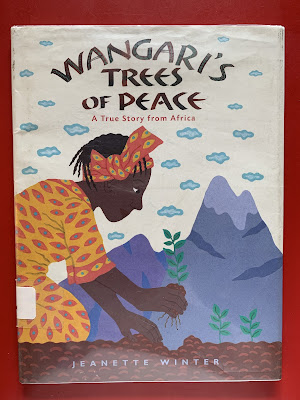
Hanna’s Comments: On the 7th day of PBT’s Picture Book a Day for a Year, I featured another book about Wangari Maathai, Planting the Trees of Kenya, a 2008 book that also tells this story. Read that post [here]. There are many picture books about Maathai’s story and movement. This beautiful book frames Maathai’s work as peaceful protest and transformation of a continent.
I decided to feature Seeds of Change because it highlights her personal story. You get an understanding of the importance of trees in her culture, her desire to go to school, her academic success, her passion for women’s rights, her prayers in prison, and how women worked together to plant millions of trees. Youth who are particularly worried about the environment will respond to this powerful story. There is some very general information about Wangari Maathai on the last page of the book. Be sure to tell your audience that Ms. Maathai died in 2011. More about The Green Belt Movement and Wangari Maathai can be found [here]. If this story is too long or complicated for your children, simply tell the story while showing the illustrations. Be sure to give credit to the author and illustrator.
Original Publisher & Date: Lee and Low Books, 2010
Age & Grade Appropriateness: 6 and up, 1st and up
Formats other than Book: None at present
Scripture Connections: Let humans have dominion over all the earth - according to Hebrew Professor Ellen F. Davis: the original word translated into “dominion” means “mastery among” or “working on behalf of”- (Genesis 1:26); God put man in the garden of Eden to work it and keep it (Genesis 2:15) also scriptures about trees (Psalm 1:3, Isaiah 60:13, Jeremiah 17:8)
Idea(s) for Application: Read this book to a group of children, youth, or adults when talking about faith-based heroes or faithful responses to creation care and environmental concerns.