Showing posts with label prayer. Show all posts

Monday, January 9, 2023

Global Hymns of Praise

Picture Book: A World of Praise

Author: Deborah Lock

Illustrator: Helen Cann

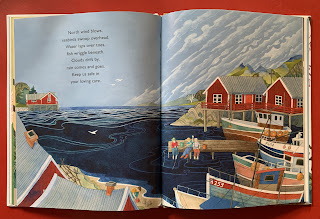
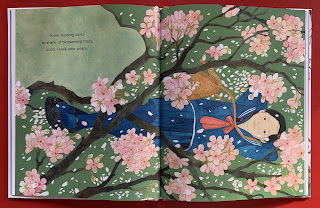
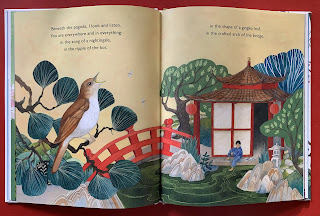
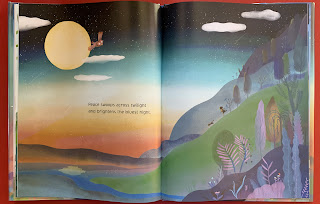
Summary: This book begins and ends with psalms! Between those pages, experience simple poetic verses integrated with beautiful scenes of diverse children enjoying the glories of God’s creation all over the world! You’ll see mountains & flatlands, cityscapes & rural spaces, contemplative children & dancing animals. Quiet praise alternates with glorious joyful noises.

Hanna’s Comments: For a children's lesson, have a globe handy and before reading, invite them to ask you where the scenes are. You’ll find a diagram in the back that identifies each of the 16 countries/regions, but you’ll need to do a bit of prep to locate all those countries on the globe. Consider placing sticky notes on the globe to make this process easier for you or for your children to do the searching. This will encourage your children’s curiosity about their world (God's world) and build their globe skills, an added benefit. Too old school for you? Add an internet component with a tablet or laptop. Repeatedly emphasize God is everywhere and the source of all!

There are not a lot of these books on the market so check with your local library system. If your library doesn’t have the book, ask if they will order it.

Original Publisher: Eerdmans, 2020

Age Appropriateness: 4 and up

Formats other than Book: None at present

Scripture Connections: You’ll find in these pages the following scriptures, but any verses about the glory, gifts, and/or beauty of nature will connect here:

Psalm 24:1-2 is on the 1st page. 

These are on the last pages:

Psalm 67:6

Psalm 113:3

Psalm 148:7-12

PBT Applications: Amidst a recording of quiet nature sounds, invite children to lie on the floor, close their eyes, and imagine portions of this book that you choose to read aloud slowly. Adapt the length of the reading so that listeners, no matter their age or attention span, can attend well and imagine fully.

For very young children, I would open this book to some favorite double page spreads and ask the children to tell you what they like and who made it. Talk about sensory experiences, especially sights/colors, textures, and sounds. Say together simple sentences, like Thank you God for birdsong! OR Thank you for making the stars so beautiful, God!

Friday, August 26, 2022

I Am Whose I Am


Despite having the same title, the books above are very different! The first book I describe below is a PBT God Book – a book about the nature of God. The great I Am, may be called by all these names and more. The second book is a book about the nature of human beings. One of God’s names, I Am, found in Exodus 3:14, serves as a core theological perspective for both books.

Both books here are board books so refrain from reading them to older children. Instead, present their ideas to older children in other ways, such as offering only the text as poetry or storytelling. Better yet, let ideas inspire you to design a game, craft, or drama.

You may not see the connection between these 2 books. Let me explain with another crucial scripture:

All humans carry in them the Image of God. Genesis explains in 2 places and then declares us good (God created humans in God’s own image... And God blessed them and called them good. Genesis 1:27 & 28a, 31). 

The 2nd book below about human nature, empowers our goodness (Dare I write God-ness?) and blessing in each of us. No matter which name we call God, “The Great I Am” is in us and provides for our resilience!

Picture Book: I Am: The Names of God for Little Ones

Author: Diane M. Stortz

Illustrator: Diane Le Feyer

Summary: Each double page of this resource book (not to be read all at once) includes several components: The Name of God, the word/phrase in its original language, a bit of a key scripture, a paraphrase of that scripture or another, a short prayer, and a beautiful illustration. Here is a quick summary of all pages. The names of God are in bold.

Creator - Elohim (Genesis 1:1)


God All-Powerful - El Shaddai (Genesis 17:1 - Abraham’s Star Promise)

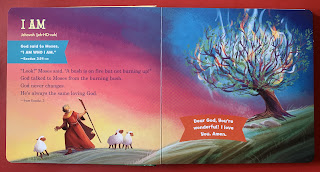
I Am – Jehovah (Moses & the Burning Bush – Exodus 3:14)


God Who Saves - El Moshaah (Moses & the Red Sea – Exodus 5, 14 & Psalm 68:20)

The Lord Will Provide – Jehovah Jireh (Abraham & Isaac – Genesis 22:14 & Manna - Exodus 16)

The Lord Who Heals - Jehovah Rophe (Exodus 15:26 & Naaman 2 Kings 5)

Son of God – Luke 1:35 (Jesus’ Baptism – Matthew 3)

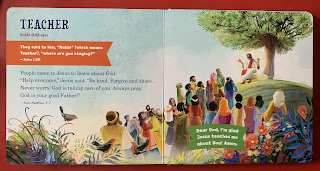
Teacher – Rabbi (Matthew 5-7)


Good Shepherd – (John 10:11 & Luke 15)

Savior – (Titus 1:4 & Luke 23-24)

Friend – (John 15:14 & 21)

King of Kings – (Revelation 17:14, Revelation 19-22)

Hanna’s Comments: Very cleverly and efficiently designed, this book gives so much in its pages! Appropriately, it is sensitive to the violence of some of these stories.


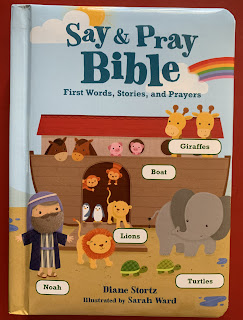
This author has also written Say and Pray Bible: First Words, Stories, and Prayers for infants and toddlers. I love its design! It uses word bubbles for building simple vocabulary around a few Bible stories. 


Original Publisher: Tommy Nelson, 2018

Age Appropriateness: 3 and up

Formats other than Book: None at present

Scripture Connections: See above

PBT Applications: Insert components of this book at the end of a children’s worship or children’s moment. Also, use it to inspire you to design a lesson for older ages about the various names for God. Encourage them to share what names they prefer for God.

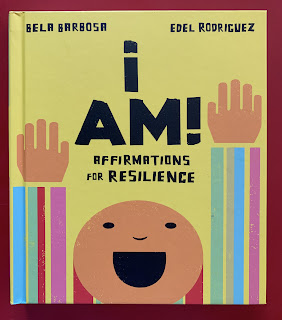
Picture Book: I Am! Affirmations for Resilience

Author: Bela Barbosa

Illustrator: Edel Rodriguez

Summary: The author calls this book a tool kit for building self-esteem and self-worth. Connect it to the scriptures mentioned above and you will help build your listeners' sense of being precious children of God, endowed with goodness, strength, and resilience. The first pages offer a bit of an emotional assessment: How do you feel on the inside? 

This book offers ways to feel better. For each double-page spreads you'll find a description of feelings, directions for a stance or fluid movement, and words to say. I encourage you to insert deep breathing, explaining that the Holy Spirit is God's breath. 

Hanna’s Comments: Movement is crucial while reading this book so have a person as a designated book holder or use a book stand while you lead the movement. Reading all these pages at once would be too much. Choose a few or use this book as a resource and insert an idea into a classroom ritual or lesson’s closing prayer. Because the body is the focus here, you can glean ideas for a lesson about The Body of Christ. Certainly, we gain strength from others too!


Original Publisher: Rise X Penguin, 2020

Age Appropriateness: 2 and up

Formats other than Book: Tablet

Scripture Connections: Any scripture about God’s strength, such as Habakkuk 3:19 & Isaiah 12:2 (God is my strength.) OR about resilience, such as the story of Ruth & Naomi. Remember PBT scripture connections can be spiritual ideas (the first example) or spiritual stories (the 2nd example).  

Connections to The Revised Common Lectionary: I listed both books in my Trinity Treasures preschool curriculum when the RCL listed the story of the Burning Bush (Year A). The 2nd book I listed for the lesson on Isaiah 12 (Year C -theme: My Strength).

PBT Applications: Use ideas for this book and integrate them into a lesson for teens about how we find strength in The Body of Christ. Together create body postures and transform them into body prayers. 


If you are interested in learning more about my Trinity Treasures, a scripture based preschool Sunday school curriculum that features picture books & children’s Bibles, contact me at hannaschock@bellsouth.net. Right now, free lessons are emailed if you agree to fill out the monthly feedback form.

Friday, July 1, 2022

Contemplate Wild Peace


Picture Book:
Wild Peace

Author: Irene Latham

Illustrator: Il Sung Na

Summary: This extraordinary book is about the peace found when imagining a nature journey, leading to observing nature in all its Godly Glory and experiencing the peace such nature provides! It is the story of a young girl who is playing in a chaotic room with her 3 siblings. She is painting a nature picture. 


Then her desire for some peace has her peering into her art and imagining where it might take her. Actually, a butterfly invites her on this expansive journey where the idea of peace simply means being who (what) God intends in a world pulsing with beauty and diversity. She is on every gorgeous page. When her figure is small, cue your audience to find her. 


The girl's explorations are to various environs where she notices animal behaviors, but there is much beauty and mystery in the plants and skies too. The last page is so profound. It shows the girl with her 3 siblings in a bed they share. Two are asleep. The youngest, a toddler, is dancing on the bed as light rays embrace each child. These are the last wise words:

Peace welcomes all that is wild and

kisses the forehead of each and every child.

Hanna’s Comments: There are many picture books about humans interacting with nature. When they are beautiful and simple, like this book, then a group can easily extrapolate deep spiritual possibilities. These kinds of books are more prevalent as our culture realizes we have deprived too many children (and adults) of these rich healing experiences, and we are all far too anxious, over-stimulated, and busy. 
This girl's journey offers peaceful quiet and leads to marvelous curiosity about God's world. Talk in particular about the animal behavior that intrigues her. What might they be teaching her about God?  Spend some time helping your audience expand their definition of prayer to include anytime they are in nature and feeling thankful, curious, or awed by God's world. 

My favorite PBT book about the peace that God's natural world can give is another secular book. Sophie is a young child who climbs a tree for comfort after she has a tantrum. She sits in the tree and seems to heal. Then she returns home. There are 2 other books in the Sophie series by Molly Bang. All are great books about managing intense feelings. 

Original Publisher: Roaring Brook Press, 2021

Age Appropriateness: 4 and up

Formats other than Book: Tablet

Scripture Connections: Any scripture about peace, such as Peace I leave with you; my peace I give you. (John 14:27) OR scriptures about quiet, such as Be still and know that I am God. (Psalm 46:10) 

PBT Applications: Read this book to a group of older children. Have them create a drama in which they are all in a chaotic room. Then one by one, they leave the chaos and do something quieter, more peaceful in the natural world. Have each tell how they have imagined themselves to be somewhere else in nature. Ask what is there that is comforting and shows God's love. End the lesson by guiding all through an imaginative prayer journey that refers to spaces already mentioned as comforting and healing. Together be grateful for such places, the skills to imagine them, and the opportunities to experience them. 


Wednesday, May 11, 2022

What Birds Teach Us

Picture Book: Ruby’s Birds

Author: Mya Thompson

Illustrator: Claudia Davila

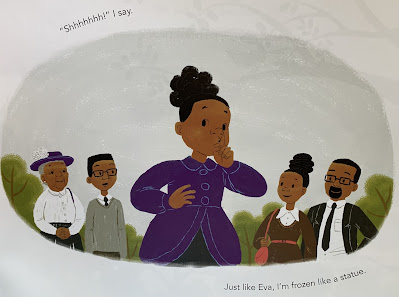
Summary: This beautiful book is from the point of view of Ruby, a girl who is 6 or so. She is about to discover the wild side of NYC! Her neighbor, Eva, offers to take Ruby to the park. Ruby assumes they are going to her play place in Central Park, but instead they are going into the forest there. On their way they sing (Ruby loves to sing – this is important!). She’s not sure what to do when they sit quietly so she bursts into song again. 
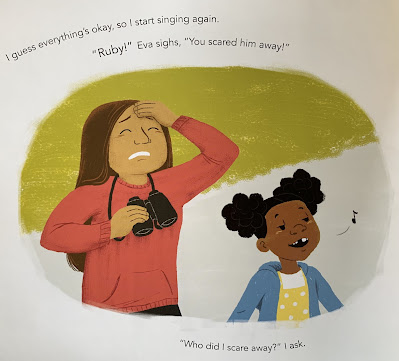

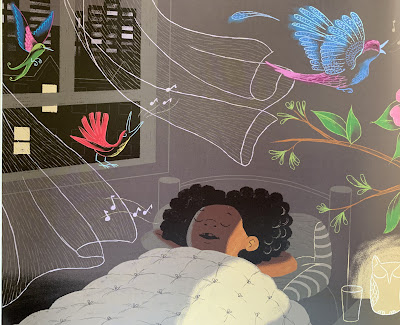
Eva gets a bit upset because she had just spied a golden-winged warbler, a bird species that Eva saw often in her home country of Costa Rica. Eva explains that Central Park is an excellent place to birdwatch. The birdwatching continues, more quietly. They don't again see the warbler that day, but Eva insists that Ruby now knows what to do to spy another one: Pay attention, move carefully, and be quiet. Ruby is already hooked! She dreams of birds after singing herself to sleep. She teaches her family about birds and birdwatching. Birdwatching becomes her very own practice.

Hanna’s Comments: Birdwatching is a lot like prayer. With a particular orientation, it can be a contemplative practice that calms, grounds, and leads us to praise. In recent years, I have discovered the contemplative and emotionally grounding aspects of birdwatching. The many birds in my feeders have helped me tremendously during the anxious days of the pandemic! I even laugh aloud sometime! Truly they are some of God's most extraordinary gifts. They are delightful to watch, but there can also be stark reminders of wild living that I don’t like to see, like violence, flying into windows & doors, and deaths that sometimes occur. Although such experiences are harder to witness, I know they are a part of creation so they should not be avoided topics of conversation should children mention them.

Because birds, like Ruby, sing so much, spend some time talking about the worship aspects of singing, particularly with concepts such as praise, awe, and gratitude. Ask children a wonder question about why they think birds sing. 

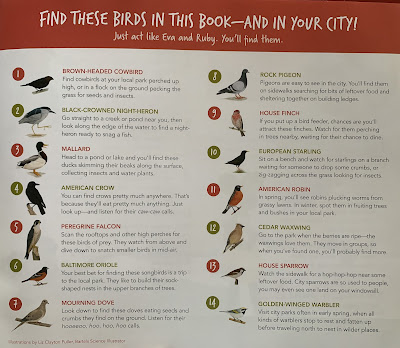
This book has an amazing number of resources in the back! First, the context of the story and some info. about warbler migration are given. Next you’ll find information about 2 key birds in the story. There is a chart listing the 14 bird species found in the illustrations. Last you have Ruby's Tips for Taking a Nature Walk. This page could be used independently on a guided nature walk later. 

Jesus tells us not to worry and references sparrows in Matthew 6:26. The concept of worrying is so important now thanks to the pandemic that I plan to do a PBT post soon that will feature several books about worrying. If you want to know now which books I plan to feature, contact me.

Original Publisher: Scholastic & The Cornell Lab Publishing Group (It is through Cornell that much excellent bird research is funded!)

Age Appropriateness: 4 and up

Formats other than Book: None at present

Scripture Connections: You may think of a couple of commonly known biblical references to birds such as, “Look at the birds of the air, they neither sew nor reap...” (Matthew 6:26) and Jesus' longing to gather his people like a hen gathers her chicks (Matthew 23:37), but there are many scriptures that reference birds! A general search engine will help you find more. Here's one I just found: Ask the birds of the sky and they will tell you. (Job 12:7)

Connections to The Revised Common Lectionary: I listed this book along with several others about birds in my Trinity Treasures Preschool Curriculum. It’s 3 years of lessons based on the lectionary. Each lesson features a list of recommended picture books. This book is for the lesson in Year B. The theme is God’s Goodness. God’s gifts of birds, flowers, and fruit are the focus. They are all mentioned in Song of Solomon 2:8-13.
PBT Applications: A couple of weeks ago I featured a book about listening. Today's book (and any book about birdwatching or nature walks) would connect with the spiritual practice of listening. However, you can also celebrate God’s diverse plan for our world by reading this book and focusing on the incredible diversity of birds in the world. I suspect you could easily create a game or art project that celebrated God’s feathered gifts. For adults or teens, ask them to tell you a parable or personal story in which a bird's presence or behavior was an important lesson.

Links to other PBT books about birds: 

How to Heal a Broken Wing

Bear and Bird

Sing...Sing a Song!


Froodle


Washing the Willow Tree Loon


Albert


Mama Outside, Mama Inside


The Birds of Bethlehem


Is This Panama?


Baby Wren and the Great Gift

Friday, March 11, 2022

Alexander's Bad Day Buddies

Wise authors are looking back at classic children's literature and realizing their value. Below I have for you 3 recently published books with plots and themes very similar to Judith Viorst's 1972 classic Alexander and the Terrible, Horrible, No Good, Very Bad Day. Don't know Alexander? Here's my PBT post about this classic! 

The healthy messages of these books are particularly important during this global pandemic! Acknowledging our feelings (confusion, anger, grief, sadness...) at home, school, and in religious settings will lead to better mental health for everyone. Here's a PBT post about that. It addresses the social-emotional needs of very young children via a theological statement that can be inserted into a secular book about feelings, BUT many books I feature there work for older children as well.

Also, I want you to know about 2 other books here if you only want to talk about sadness. Perhaps your congregation is grieving a loss or significant change. Click on titles to read posts about these very different PBT books: 

The Blue Day Book for Kids


When Sadness is at Your Door


Now back to Alexander's literary influence... 
Below find some information about how the 3 new books photographed above are different from Viorst's classic. In general, there is less text in all 3 books so they are quicker reads. From the covers, you'll see the diversity they offer. At the bottom, I give a few ideas about how these books tie to scripture and might be used in ministry.

Picture Book: Keep Your Head UP

Author: Aliya King Neil

Illustrator: Charly Palmer

Summary: This beautiful book is quite similar to Alexander, but it has the wisdom of some modern psychology. D. is a little older, a tween or young teen. D. reminds himself that "Any day can be good if you try." And he does try, but the frustrations of home and school pile on him. When D. has a "meltdown," he is sent to the principal's office, where he is greeted by Miss King, who has been helping him. Her role is unclear, likely a school counselor or school psychologist. D.'s family is also helpful. They set reasonable limits, talk openly about his feelings, and encourage him to "Keep his head up." When he doesn't want to, D. knows he can at least try.

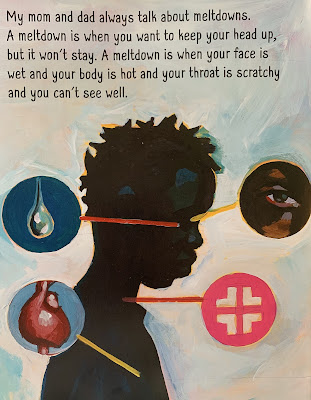
Hanna’s Comments: In addition to the very real details and modern school setting, loving home, and non-white characters, what I like most about this book is the way D. is perceptive about his feelings and specific about their effects. He says he feels scrunchy and describes his face changes (scrunchy eyebrows). He even describes a meltdown! (see image above) There is some great information for discussion here! Do tell your audience that we can't always be expected to keep trying to feel better. Sometime we have to accept our feelings while maintaining control of our behavior. Offering ideas of "loving our neighbors" is important to add here.

Original Publisher: Simon & Schuster, 2021

Age Appropriateness: 5 and up

Formats other than Book: Tablet


Picture Book: Benji, the Bad Day, and Me

Author: Sally J. Pla

Illustrator: Ken Min

Summary: Here the most significant and welcome difference from Viorst's classic is that the main character is an older brother to a child on the autism spectrum. This difference offers opportunities to talk about the importance of empathy, prioritizing people's needs, and concepts of fairness & justice. Although the older brother's  day has gone terribly, his mother is very focused on her younger child's significant needs. It is the younger brother who finally offers comfort to the main character. Then mom, who no doubt needs comfort too,  joins in, and the story ends beautifully.

Hanna’s Comments: It is the younger brother who is named Benji. This is confusing. Benji is a pivotal but mostly peripheral character. The older brother, who is telling the story, is Samuel. I suggest giving their names when showing the cover before reading. Whenever I find myself occupied with trying to figure out who is who, I am not able to focus on a story. 

Original Publisher: Lee & Low, 2018

Age Appropriateness: 5 and up

Formats other than Book: None at present 


Picture Book: Kevin the Unicorn: It’s Not All Rainbows

Author/Illustrator: Jessica von Innerebner

Summary: Alexander and Kevin's worlds are about as different as they can be! Kevin is expected to be perfect and everyday is expected to be sparkly - "filled with MAGICAL AWESOMENESS!" But Kevin, like Alexander, D. and Samuel, is having a bad day. Although he tries to be joyful, the constant barrage of positive messages in Kevin's world only confuse him. Eventually, he can no longer hide his feelings. His declaration invites others to be more honest about the bad day they are having. Kevin is not alone in his feelings. Such connections are crucial to humans and even unicorns, I suspect!

Hanna’s Comments: I must admit, this cover and title turned me off. But then I read the story! What wisdom there is between the lines of this silly and saccharine book! As an Enneagram 7, it is a story I needed. You have children who need to hear that it is acceptable and inevitable to be imperfect and upset, and to have a bad day. This book is full of funny word play. Read it with drama and silliness. But before reading, invite your audience to notice minor characters and consider how their days are going. Turn pages slowly so they can comprehend detail. 

Given the color palate, I hope you won't assume this is a book for girls only. The main character is named Keven, after all. At present, there is another book about Kevin the Unicorn: Why Can’t We Be Bestie-Corns?

Original Publisher: Dial Books, 2019

Age Appropriateness: 4 and up

Formats other than Book: Tablet

Scripture Connections for these 3 books: Any scripture that involves Lamentation or Complaint to God connects to these books.

OR Bible stories about characters that are suffering, such as Job, can be particularly powerful. Try not to get into why bad things happen. 

OR Get into the details of The Great Commandment. What does it means to love yourself AND love your neighbor when you are having a Terrible, Horrible, No Good, Very Bad Day?

PBT Applications: Read any of these books to dive into what lament looks like. Legitimize it as an important kind of prayer. Talk about how there is a whole book in the Bible named Lamentations and how many of the Psalms include  complaints to God. More importantly, emphasize that God and those who love us most, want to know our real feelings. They can handle our negative feelings and can likely help us understand or move through them better. Sometimes just saying, "I am having a bad day!" is enough to help us feel better!

Monday, August 23, 2021

Be Still... & Other Favorite Scriptures


Picture Book: Be Still

Author: Kathryn O’Brien

Illustrator: Gillian Flint

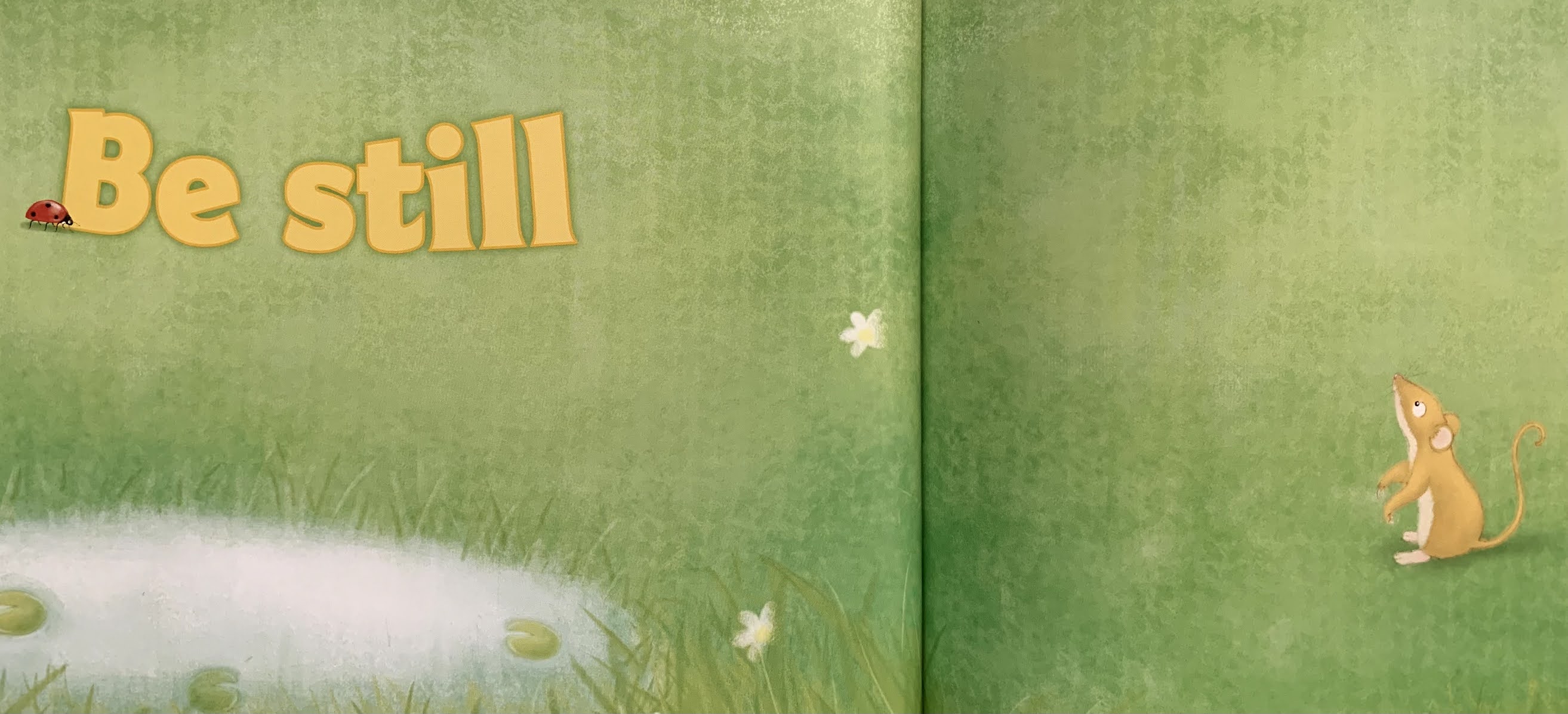
Summary: Designed to help a child memorize Psalm 46:10, this book reveals the words of this beloved scripture 1 word per double page spread. 

After each word is revealed, the concept is built like this:

Be kind. Be silly! Be a friend. Be yourself.

In the images, young children are enjoying being mindful of God’s presence and the beauty of God’s creation. Here are the next 2 images so you can see how the pages reveal the scripture and build the meaning:

Shhhh. Slow down. 

Take a breath. 

No hurrying or scurrying or worrying. 

No wanting or whining. 

No fussing. No rushing.

Safe and still.

Don’t let this limited purpose distract you from seeing other obvious applications beyond memorization! Because each word is explored in the pages, each page can be discussed. There is a note at the beginning of the book urging parents to teach scripture to their children. This can be a very meaningful practice, but exploring what memorized scripture means is crucial so that it grows in meaning with age and experience. This book and others in the series (see my comments below) offer opportunities for meaningful prayer which is what the children are doing on these pages! They are oriented to and communicating with God. 


Hanna’s Comments: This PBT post is really about 3 books in a series. They are all structured as described above. Confusingly, the books seem to be in 2 named series: Sit for a Bit or My First Bible Memory Book.

The other 2 books in the series are…

    I Can – highlighting Philippians 4:13

I can do everything through Christ, who gives me strength.


    Give Thanks – highlighting Psalm 136:1

Give thanks to the Lord, for he is good.

Hopefully, other books based on other important and easy to memorize scriptures will be added.

Original Publisher: Tyndale, 2016

Age Appropriateness: Preschool & up

Formats other than Book: None at present

Scripture Connections: See above. Each of the 3 books mentioned are focused on a particular scripture. More may be published!

Connections to The Revised Common Lectionary: I have recommended each of these 3 books in my Trinity Treasures curriculum for preschoolers based on the the RCL. 

PBT Applications: Read these books to preschoolers or elementary-aged children.

For Be Still, have them experience a Christian-based mindfulness practice, while focusing on their breath and God's presence.

For I Can, have them watch a superhero movie together. Talk about how God is the source of your strength and give examples of when you relied on God’s strength to be resilient. Invite your children to do the same. End with talking about the importance of learning scripture as a way to gain strength and perseverance.

For Give Thanks, have them go outside and secretly draw 1 aspect of creation that they are thankful for. Then have them come inside to play a game of charades so others can guess what they have drawn. To end, together create a litany of thanks or a collage of gratitude. 

If you are interested in learning about Trinity Treasures, a scripture-based preschool Sunday school curriculum that features picture books & children’s Bibles, contact me at hannaschock@bellsouth.net. Right now, free lessons are emailed if you fill out the monthly feedback form.