Showing posts with label the environment/nature. Show all posts

Monday, January 9, 2023

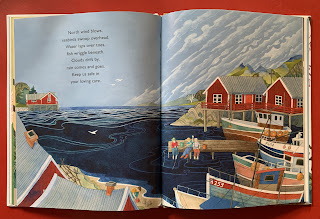
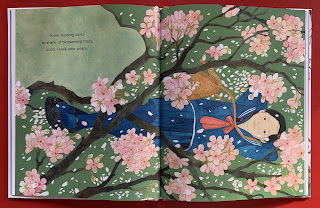
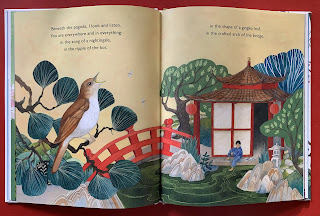
Global Hymns of Praise

Picture Book: A World of Praise

Author: Deborah Lock

Illustrator: Helen Cann

Summary: This book begins and ends with psalms! Between those pages, experience simple poetic verses integrated with beautiful scenes of diverse children enjoying the glories of God’s creation all over the world! You’ll see mountains & flatlands, cityscapes & rural spaces, contemplative children & dancing animals. Quiet praise alternates with glorious joyful noises.

Hanna’s Comments: For a children's lesson, have a globe handy and before reading, invite them to ask you where the scenes are. You’ll find a diagram in the back that identifies each of the 16 countries/regions, but you’ll need to do a bit of prep to locate all those countries on the globe. Consider placing sticky notes on the globe to make this process easier for you or for your children to do the searching. This will encourage your children’s curiosity about their world (God's world) and build their globe skills, an added benefit. Too old school for you? Add an internet component with a tablet or laptop. Repeatedly emphasize God is everywhere and the source of all!

There are not a lot of these books on the market so check with your local library system. If your library doesn’t have the book, ask if they will order it.

Original Publisher: Eerdmans, 2020

Age Appropriateness: 4 and up

Formats other than Book: None at present

Scripture Connections: You’ll find in these pages the following scriptures, but any verses about the glory, gifts, and/or beauty of nature will connect here:

Psalm 24:1-2 is on the 1st page. 

These are on the last pages:

Psalm 67:6

Psalm 113:3

Psalm 148:7-12

PBT Applications: Amidst a recording of quiet nature sounds, invite children to lie on the floor, close their eyes, and imagine portions of this book that you choose to read aloud slowly. Adapt the length of the reading so that listeners, no matter their age or attention span, can attend well and imagine fully.

For very young children, I would open this book to some favorite double page spreads and ask the children to tell you what they like and who made it. Talk about sensory experiences, especially sights/colors, textures, and sounds. Say together simple sentences, like Thank you God for birdsong! OR Thank you for making the stars so beautiful, God!

Wednesday, December 21, 2022

3 Books for Winter Solstice

Some churches are having Winter Solstice or Longest Night worship services. They view this as an opportunity to acknowledge the darkness of the season, particularly for those who have experienced loss or those who don’t find the hope of Advent as easily as our culture expects. 

Below I give you links to a couple of PBT books that could inform your worship planning. Also, these books could be read or their stories told to worshipers. 

Next, I feature an extraordinarily beautiful new book about darkness and light. It nicely connects to Jesus’ lost parables, but it could also be read aloud on Winter Solstice, when a conversation about holy darkness is potent with meaning.

Owl Moon, a beloved classic, amazingly could be read anytime during Advent (It is about longing and involves patience and silence.) and for Epiphany (It is about a journey in the dark.) On the longest night, it has particular resonance because of the family's milestone ritual - a dark search for an owl.

Singing Away the Dark is the author's very personal childhood story about how darkness on her way to school was frightening, but singing helped her manage her fears.


Picture Book: Dark on Light

Author: Dianne White

Illustrator: Felicita Sala

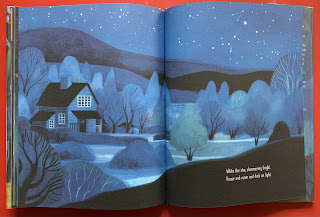
Summary: This book begins and ends with the same view: The first at sunset & the last at sunrise. 

But the point of this story is "Even when it is dark outside, there is still so much light."  Three young children look out the window as the sun goes down. 
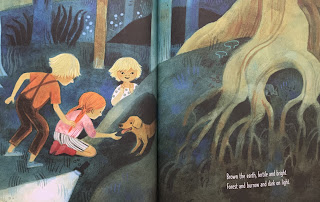
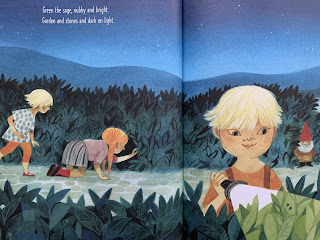
The 3 go out the front door despite the darkness, flashlight in the hand of the oldest, with no adults. With poetic verse, the book celebrates what and who (Many animals & plants!) are sensed on their night journey. Are they exploring? On a night hike? No. It becomes apparent they are searching, at least the 2 oldest are. The youngest is distractedly playing! 

Earlier, on the 2nd double page spread, a dog has wandered from the home. This is who the children are seeking! This is who they were looking for through that window!

The beloved dog is found and greeted. 
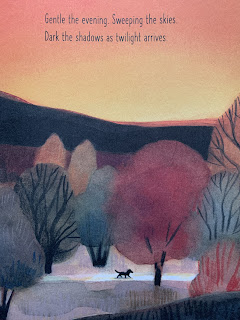
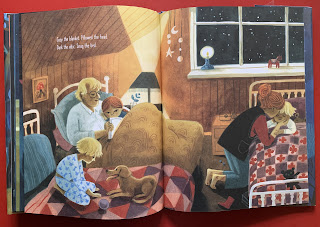
Then all are made aware of the glorious sky! (See image at top.) All 4 head home and are lovingly greeted by the 2 adults (parents? grandparents? You decide.), who take them straight to their shared bedroom. There loving security is present in every nook and gesture so that a sleepy peace comes to all, especially the one lost then found.
Hanna’s Comments: The goal of finding the missing dog can be easily missed at a first reading. Once the dog was found, I realized they had snuck out to search. I went back to earlier pages and saw what I had missed. I suggest you introduce the book by reading the author & illustrator's names (Always do this!). Then say, "This is a book about 3 children who decide to go out at night because someone they love is missing." 

As you read, point to the details you don't want missed and teach some new vocabulary (sage, noble, sapphire...). With young children, together count the animals before turning the page. Choose 1 animal to say a quick prayer of thanks or praise to God. 

Encourage natural wonder about other living things, the darkness, and God's mysteries. Components of the story that you might want to use in a lesson include flashlights, sage, and lavender. An experience with essential oils would be a nice touch! End with an imaginary journey prayer about the dark. Encourage being mindful of God's treasures in darkness and thankful that God is with us always, everywhere, in light, dark, and when both are present, as is often true. 

Update: This author has published a similar book about the cycle of a day. It’s called Blue on Blue. It would be a great book for teaching gratitude practices across a typical day.

Her book Green on Green moves through a traditional North American seasonal cycle, including Thanksgiving and Christmas traditions. Those holidays are not named. However, the usual rituals are evident. Therefore, this book would serve well as a component of a lesson on the importance of seasonal and holiday rituals. Be sure to tie such rituals to God’s provisions.

Original Publisher: Beach Lane Books, 2022

Age Appropriateness: 4 and up

Formats other than Book: Tablet

Scripture Connections: Jesus' 3 lost parables (Luke 15:1-2) or any scripture about searching such as the "pearl of great price" (Matthew 13:45-46) OR how the light of love gives us courage in metaphorical or real darkness such as Ruth and Naomi must have experienced on their journey to Israel. 

PBT Applications: Read this book on the Winter's Solstice or to a group of children anytime of year to explore Jesus' lost parables. Spend extra time on pages that show the children's bedroom. Discuss the comforts of bedtime rituals & objects that help us feel safe and loved. Ask about feeling God's presence in bed.

Saturday, December 10, 2022

3 Ellie Holcomb Books (1 for December)

You may know Ellie Holcomb as an award-winning Christian singer/songwriter, a solo artist and a member of her husband Drew Holcomb's band. Her books share several attributes: 

  • They are large board books. I’ve written that too many abstract or lengthy books are being made in board book form, which will turn off a child beyond the need for those kinds of books. All are available in tablet form.
  • They begin broadly with abstract possibilities that explore questions. Midway they become theological. I recommend them for age 4 and older, despite them being board books.
  • The 2 non-Christmas books align with an album which must be purchased separately. There may be a Christmas album eventually.
  • All are written in verse so practice before reading aloud.
  • She uses masculine pronouns for God. If you choose, adapt easily with sticky notes that cue you to use the words you prefer.
  • The images are of diverse children interacting with wild animals in extraordinary ways. 

These images are similar to Nancy Tillman's beautiful books. Find a few of those at PBT HERE  AND HERE.


Picture Book: Sounding Joy

Author: Ellie Holcomb

Illustrator: Laura Ramos

Summary: This book begins with the question: What does joy sound like? It answers with possibilities of child characters experiencing joy in winter. Snow sounds like the laughter of friends, deep breaths when playing games are joy sounds, and hooraying while sledding is a glorious joy noise. Next it says glorious joy long ago sounded like angels’ wings. Suddenly, the modern setting reverts to shepherd children in Bethlehem witnessing a sky full of singing angels! With reverence, the little shepherds visit Jesus at the manger where “God bent down low and sent us His son to make heaven our home.”

Hanna’s Comments: The sentence above doesn't express my theology regarding the purpose of Jesus’ birth, but I try at PBT to not limit your access to good books when they don’t line up with my personal theological ideas. What this book does offer in abundance is joy grounded in a loving God whose creation and incarnation via a human child are very much worth celebrating.

I also like how she ties the lights we see at Christmas to the glory of the angels and encourages her audience to respond to Christmas by sounding joy and being loving.

Original Publisher: B&H, 2022

Age Appropriateness: 4 & up

Formats other than Book: Tablet

Scripture Connections: There are many joyful sounds in the Christmas story. Those animals couldn’t have been quiet! And the choir of angels were the ultimate joyful noise! Also, Make a joyful noise… works well here (Psalm 100:1-5)

PBT Applications: Read this book at a Christmas day children’s church gathering. Remind all that the joy and rituals we experience this season are about God’s loving generosity. Talk about your audience's most joyful moments this season and help each find the gift God has given in each circumstance.


Picture Book: Who Sang the First Song?

Author: Ellie Holcomb

Illustrator: Kayla Harren

Summary: This book’s title question is directed at a group of children. In verse, it describes possibilities. Was the first song sung by the sun? Whales? Flowers? etc. Then it explains that God wrote the first song into everything and everyone. We and all creation are wonderfully made so let's sing our unique songs, while being who and what we were created to be. Good. Beautiful. A reflection of our Creator.

Hanna’s Comments: I like the possibilities that the first pages offer. These can lead to some imagination-fueled conversations. Ask what might the songs of birds say about God? When Holcomb dismisses ideas of earthly creations having  sung the first song, it's a bit jarring, but she quickly explains the goodness of creation and urges all to sing songs they were created to sing. If God sang the first song during creation, then God wrote God's own song into everything  and everyone. God's singing and our extraordinary songs continue. Psalm 150:6 exhorts all breathing creatures to praise God.
Original Publisher: B&H, 2018

Age Appropriateness: 4 & up

Formats other than Book: Tablet & and an album - Sing: Creation Songs

Scripture Connections: We are wonderfully made with an ever-present God to stir us into song (Psalm 139); Make a joyful noise… works well here too (Psalm 100:1-5); Let everything that has breath praise the Lord. (Psalm 150:6)

PBT Applications: Read this book to a group of children who are learning that worship can be noisy. And quiet. And even sad or angry as in a lament.


Picture Book: Don’t Forget to Remember

Author: Ellie Holcomb

Illustrator: Kayla Harren

Summary: The question that begins this book is Did you know creation is talking to you? What follows is encouragement to all to listen and remember what God teaches through creation. Creation might be heard anywhere. In the photo below, the ocean sings a reminder that God's love never ends. A sail is a metaphor for being filled with God. 

We can hear God's voice at anytime. Snowflakes whisper we too are unique. 

Each sunrise silently sings of God's loving presence. 
Hanna’s Comments: One of my favorite prayers begins, "New every morning is Your love, oh God of light. And all day long You are working for good in the world." This book reminds me of that assurance. Throughout this book implores us to be open to God's presence, listening to what God is singing and showing. 


Original Publisher: B&H, 2020

Age Appropriateness: 4 & up

Formats other than Book: Tablet & an album - Sing: Remembering Songs

Scripture Connections: The image above is a reminder of many scriptures in which God is said to be light (Isaiah 9:1, 1 John 1:5 are 2 examples). Other scriptures that would connect with this book are those about God's constant presence (i.e., Psalm 139:7-10) and instructions to listen (i.e., James 1:19) and remember (i.e., Psalm 103:2).

PBT Applications: Read this book to a group of young parents. Then spend time talking about what reminders of God they want their children to have and how they can encourage these while outside.

Thursday, September 22, 2022

Our Home: Our Earth


Below I describe a brand-new book by one of my favorite picture book authors! This book will have your audience thinking seriously and expansively about Earth, our Dot - the home we all share.

Picture Book: Here: The Dot We Call Home

Author: Laura Alary

Illustrator: Cathrin Peterslund

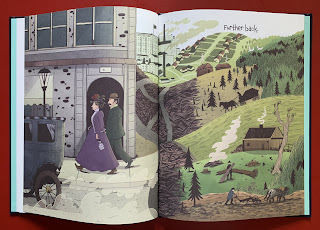
Summary: This beautiful book offers a wise young girl's wide view of home, time, and space. Beginning in her bedroom and moving outwardly, she draws a line between her house now and before she lived there. She explains that others who lived there left behind things: good things (a tree swing, a secret hedge) and some unwanted things (junk). Wisely she offers the same thought exercise to her city and then our Earth. She invites the reader to go back (turn the page) and see how her city has changed. Historical elements are shown.


Then the illustrator shows the ugliness in some places because other things were left behind.
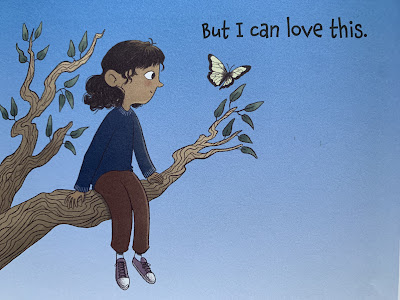
Our intelligent tour guide ends this thought exercise with a far view of our globe; Dot can look very small from space. She lovingly wishes she could care for all of Earth for the people who are to come after her. "But it is too big. And I am so small." So she engages in a beautiful practice! When feeling overwhelmed by the issues of our globe, she says to herself, “But I can love this... and this."
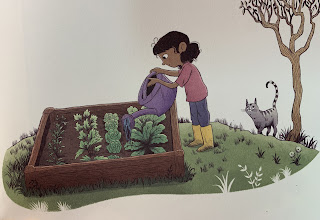
Mindful moments and small acts of creation care serve to boost her hope about the resilience of our home and its inhabitants. 

Hanna’s Comments: Alary & Peterslund offer a remarkable construction of the breadth of the subject of home and the details that give it beauty and meaning. Through a thoughtful imaginary journey to the past and consideration for the future, the narrator models how to sense a calling for the present! The clarity & detail of the illustrations tell stories beyond the words so be sure to spend some time exploring those images. This keen-eyed girl invites all to gaze gratefully. She may be small and the subject of her worries big, but her vision and agency are expansive. Let her encourage your own children to care for our Dot so that we don't leave so much ugliness behind.


Below I have links to other Alary books featured here at PBT, including a Guest Author post - my first! Why do I like her books so much? Like in this book, Alary offers a clever slant on Truth, Faith, and Holy Love. For those of you doing family ministry, you'll want to explore her Bible for tweens & teens and her liturgical resource books which are full of clever ideas for making church seasons meaningful! All her creations can be found HERE


Original Publisher: Paraclete Press, 2022

Age Appropriateness: Age 3 and up

Formats other than Book: Tablet & Audiobook

Scripture Connections: There are so many scriptures about home and our Earth, particularly land! Here are a few: 

The creation narratives (Genesis 1 & 2)

The Israelites longing for home while exiled in Babylon (Psalm 137)

For you shall not pollute the land... (Numbers 35:33)

I lift my eyes to the hills... (Psalm 121:1)

The wise woman builds her house, but with her own hands the foolish woman tears hers down. (Proverbs 14:1)

The Earth is polluted by its inhabitant... (Isaiah 24:5)

… if anything is excellent and praiseworthy, think on these things. (Philippians 4:8)


PBT Applications: Read this book to a group of children in your church who are about to engage in some creation care or environmental justice activities. It will motivate them and give them a wider sense of purpose and "grounded" joy! Have them offer contrasting gratitudes to God: 
    something small then something big
    something personal then something shared by all
    something natural then something human-made
    something microscopic then something in outerspace

Links to Laura Alary here at PBT: 

Thursday, July 14, 2022

A Heroic Hummingbird

Picture Book: The Little Hummingbird

Author/ Illustrator: Michael Nicoll Yahgulanaas

Summary: Based on an indigenous story, this book begins with a group of forest animals. When “the great fire” starts, animals huddle at the edge of a forest. 


They wonder what they can do, but they are afraid and feel helpless. As the forest burns, Little Hummingbird flies between the stream and the forest, carrying one drop of water per trip and dropping it onto the ferocious blaze. 

The other animals watch in amazement and offer excuses. Eventually, Big Bird asks Little Hummingbird, what she is doing. She responds, “I’m doing everything I can.”   
Hanna’s Comments: This very short book offers a straightforward message and lots to explore! Primarily there is the message of taking responsibility for what is happening in your world by doing the best you can. How do you talk to children and adults about taking responsibility? By helping them identify and emulate the heroes in pop culture and the more elusive heroes in their midst. Then find connections between ALL those heroes and your audience. Next make connections to heroes in Bible stories. Below I list a few standouts in categories I call traditional and nontraditional biblical heroes. Nontraditional biblical heroes, like the Little Hummingbird, are doing small acts, often over a long period of time. Sometimes these nontraditional are noticed and honored, but often they are not. Look at the biblical stories of the unnamed, the less dramatic acts, the people on the margins that Jesus so clearly saw. My favorite Bible hero is the woman who touches Jesus' hem. She is quiet in her courage, but nevertheless her courage is very big. Already shunned, she risks even more by entering the crowd and touching the man of the moment. She was seen and healed by Jesus because of her faith, but the healing would have never happened had she not been courageous!  


Notice that the Little Hummingbird is a female. This is a great chance for your females to hear a female hero story in this book and in scripture. Don't use the word "heroine." It implies a weaker, softer sort of hero. The word hero is big enough for all genders!


There are 2 enlightening Afterwards in this book. The first is by the author who explores the amazing abilities of hummingbirds. He says they often represent beauty, agility, and hope in traditional stories throughout the Western hemisphere. The 2nd Afterward is by Nobel Laureate Wangari Maathai, who taught southern Africa and later the world, that planting one tree at a time until you’ve planted millions can make a huge difference in land damaged by chronic abuse! I have 2 books about her posted at PBT. Click HERE   

and HERE TOO! There are many picture books about this great hero!

Original Publisher: Greystone Books, 2010

Age Appropriateness: 5 and up

Formats other than Book: Tablet

Scripture Connections: Any scripture about heroes in the traditional sense (David in the Goliath story - 1 Samuel 17) and nontraditional heroes who made a difference with small gestures (the woman who touched Jesus' hem - Luke 8:43-48 & the boy who shared his food - John: 6:5-14) and heroes with long term commitment (Ruth's entire story & Priscilla and Aquilla - in Romans 16:3 Paul calls them his co-workers in the ministry of Christ Jesus who “risked their necks”).   

PBT Applications: Read this book to a group of tweens or teens who you hope will become passionate about a social justice issue. Make connections to other heroes as described above. You may choose to tell this story as a parable. Then have each choose an animal and offer a plausible excuse or whine of resignation. Make connections to people who give excuses and don’t act. Tell stories of local heroes and heroes in your church family. Allow this story to motivate them to make specific plans to act responsibly and "do all they can" regarding the issue. Compel but also inspire!