Monday, March 19, 2018

Seeds

Picture Book: What Will Grow?
Author: Jennifer Ward
Illustrator: Susie Ghahremani
Summary: It's almost spring here in Alabama so it's time for folks to plant seeds.
This gorgeous book introduces young children to the idea that seeds are varied and determine what will grow. In the back you'll find lots of information about common seeds 
and the 4 stages from seed to plant.
The title question is asked and answered after each seed is described in a fun rhyming couplet. 
Sometimes the seed is described, the question asked and then ...
you are treated to an extra, fold-out page.  
Big plants for climbing are here. 
 
The origins of common flowers are considered. 
And an uncommon flower is featured  
with a surprising fold-out treat! 
But this book is not just about the plants we expect to enjoy in spring and summer. 
Some we harvest in autumn
and some we celebrate in winter. 
Here's another gorgeous surprise. 
You'll find animal interactions which you can expand on with more science, helping children understand the God-ordained interactions of plants and animals. 
The parts of a plant are mentioned 
as well as the different directions of growth. 
The wrap-up shows the busyness of the underground 
and the results of all that work and time. 
Hanna’s Comments: Because the Bible was written in an agrarian culture and a simpler time, seeds are used repeatedly as literary illustrations of godly potential. Their symbolism is straightforward and relateable to young and old. Each seed has the godly wisdom to grow in its own way just as we have God's image in us to bless the world. Although we are each a unique seed with varied potential, our genetics tie us to other humans, particular animals, and the plants we depend on.   
The first book in Ward & Ghahremani's series is What Will Hatch? 
Likewise, in that book the author/illustrator duo transform a set of simple scientific ideas about eggs into beauty we can then use for spiritual metaphors. The beautiful pages in both books (my photos don't do them justice) are thick for little hands to turn. 
Original Publisher & Date: Bloomsbury, 2017
Age & Grade Appropriateness: 2 and up, Toddler and up
Formats other than Book: None at present
Scripture Connections: Scriptures about the image of God in us, seed parables, and our connections with plants and other animals
Idea(s) for Application: Read this book during a lesson for young children in your faith family and link to scriptures in which seeds symbolically represent potential.

Friday, March 16, 2018

PBT Question #5 to Ask about Any Secular Book


Does this book have the potential to positively affect the behavior or future of those who experience it? 

Good teachers teach to improve the quality of audience members' lives. With this last question, PBT encourages you to consider the future of your listeners' understanding of God, their places in a family of faith, or their relationships with The Holy.


PBT is all about connecting the content in picture books to scripture and/or spiritual truths so that spiritual growth can be more personally meaningful. Longer lasting learning occurs when theological ideas are connected to realistic situations or meaningful concepts. What affects you connects you!

Asking yourself how a picture book will positively affect your listeners is a worthy consideration that gives focus to your planning and teaching.   

As a nationally certified school psychologist, I’m passionate about improving social and emotional skills; those include spiritual skills. Modern psychological research is finding that social and emotional learning (SEL) and its affects on behavior is crucial for success in all relationships as well as in academic learning. For more on this critical link, check out www.casel.org. CASEL has identified 5 Interrelated Sets of COGNITIVE, AFFECTIVE, AND BEHAVIORAL COMPETENCIES: Self-Awareness, Self-Management, Social Awareness, Relationship Skills, and Responsible Decision Making.
 
With this last PBT question, I’m offering an example book, Just a Dream by Chris Van Allsburg (see my PBT re-post where I offer it as a Grab & Go book [here]). It's a story of a careless boy and his discovery of an array of environmental concerns. 
Connecting this story to God’s desire that we have respectful and intelligent guardianship of Earth’s inhabitants and resources might inspire listeners to evaluate their relationship with the Earth. They could find connections between their behavior and the Earth’s health and see this as a God-ordained relationship. Additionally, this book addresses all 5 of CASELs competencies listed above. 

Here are a couple of amazing illustrations from Van Allsburg. First, I show a scene from Walter’s bad dream. 
 
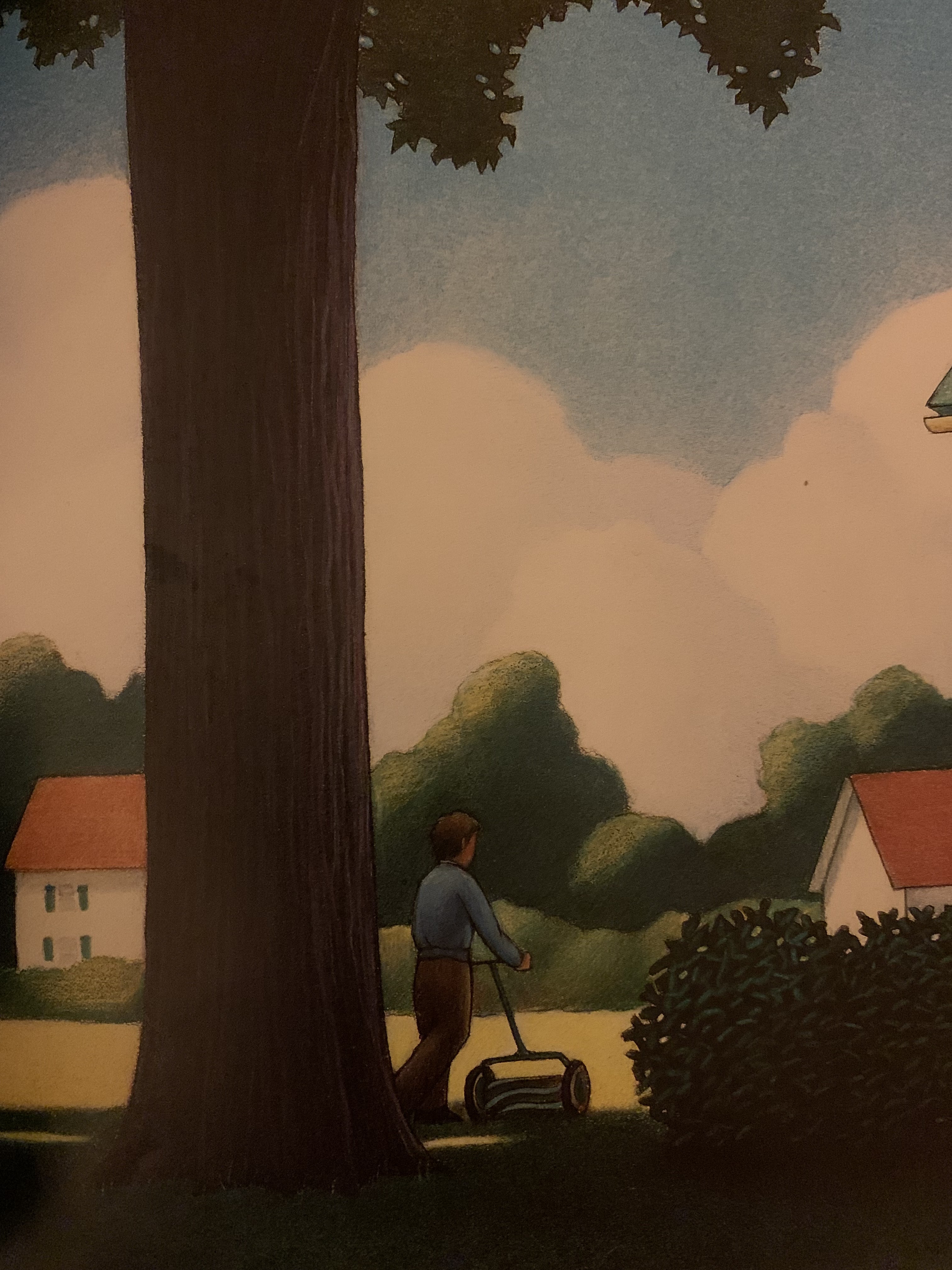
Here is a “post-dream” scene in which Walter plants a tree for his birthday:
 

This book is one of many possible books about positive behaviors. Here are others from the PBT archives:
Judgement vs. Acceptance - You Are (NOT) Small
Health & Self-Understanding - many I Am books
Learning from Nature - Ruby's Birds
Compassion - What Happened to You?
Building Community - Circles All Around Us
Inclusive Behavior - The Big Umbrella
Loving Behavior - various Bucket books
Responsibility - The Little Hummingbird

Here's another strategy: Think of an important SEL skill, find it or a related word in the large list of search words at the bottom of this screen (on the web version), and see the vast potential PBT has for your ministry and/or your family. May your own SEL learning be enhanced as you teach!

Monday, March 12, 2018

Beauty, Gratitude, and Worship

Picture Book: For the Beauty of the Earth
Author: Folliot S. Pierpoint
Illustrator: Lucy Fleming
Summary & Hanna’s Comments: Hopefully you know this hymn which was written in 1864 and is still sung across worship communities and settings. 
I was thrilled to see it become a picture book! We requested that it be sung when each of our children was baptized so it has extraordinary meaning in our family. 
The most famous hymn from this English hymnist, its lyrics are a bountiful celebration of a spectrum of God’s great gifts. The illustrator offers rich imagery of the lyrics. 
Initially, I love this hymn (and admire this book) for its affirmation of God's glory in nature. 

It also emphasizes the gift of love that surrounds us upon our birth and raises us in family.

This hymn acknowledges community in all that is Holy 
and the opportunity for worship in the glory of nature.   

Here you have diversity, in nature and people, honored as one of God's greatest patterns. 
A variety of human activities are shown. Each of them honoring our Creator God. But as you might expect from the title, the focus of this book is on the spectacle of God's glory outdoors. 
This is a picture book about worship, not just praise but contemplation, gratitude, and connection to everything that is Holy. 
In one of the later verses, you're given traditional images of  The Church Universal who is "offering a pure sacrifice of love."  
If only this was always so and if only the illustrator had chosen to show Church in non-traditional ways as well, apart from a building. 
This gorgeous book ends with a fervent hope for peace.
The score is in the back so that you can sing it together as you enjoy the illustrations. The text is rich enough to feature in a series of ministry experiences and family readings. This would allow your audience to become comfortable with the text and their singing. 
Original Publisher & Date: Sparkhouse Family, 2017
Age & Grade Appropriateness: 4 and up, Pre and up
Formats other than Book: None at present
Scripture Connections: Scriptures about gratitude, Earth’s beauty, and God’s glory would all connect to this picture book.
Idea(s) for Application: One of many applications of this book in ministry is to use it in a lesson that introduces an exploration of why and how we worship God, where and when we may worship, and how that has changed personally or throughout Christian history.