Monday, April 10, 2017

PBT Techniques #5 Using Poetry in Ministry

Picture Book: In Every Grain of Sand: A Child’s Book                                                      of Prayers and Praise
Collected by: Reeve Lindbergh
Illustrators: Christine Davenier, Bob Graham, Anita Jeram, and Elisa Kleven 
Summary: This beautiful collection offers verses of praise, such as an Homage to God,
in appreciation of nature, 
and to celebrate ordinary things. 
Each of the 4 sections offer various writers and only one illustrators' renderings. There are poems, prayers, and sayings categorized for the day
for the home
for the earth
and for the night. 
You’ll find poems from The Old Testament. Here's the 23rd Psalm.
The New Testament: The Lord's Prayer with elephants and moneys!
And other Jewish writings are here.
You'll find prayers from various religions 
and cultures
ancient writings
and relatively new verses, like these from Schweitzer and Hugo.
Some writings are from beloved saints such as Julian of Norwich
and some from heroes, like Anne Frank.
Hanna’s Comments: April is National Poetry Month here in The States so I wanted to suggest some ways you can use picture book poetry in ministry, classrooms, homes, or even in a therapeutic setting.
If you need a quick closing for a Sunday school lesson, a well-selected poem will do, like this Gaelic Blessing.
If you are basing a lesson on a Psalm, consider locating one in a picture book to use in the heart of your lesson. Have your audience create their own illustrations for the Psalm.  This picture book has versions or verses from Psalms 23, 118, 121, & 139.
If you want to help your faith-family become more comfortable with body prayers, songs of praise are wonderful verbal prompts. Look for words that would lead to some particular gestures.
If you want to use a poem in worship, choose a poem in a picture book and project the image on a wall or screen. This one would be beautiful!
If you want to do a private school or home school lesson on spiritual poetry or comparative religious poetry, your children will love this book!
If you’re doing some pastoral counseling or spiritual direction, this book would provide enough diverse writing for a great homework assignment.
If you have other ideas, please share them via a comment. In the back of this book, you’ll find an Index of First Lines that will help you make some choices.
Original Publisher & Date: Candlewick Press, 2000
Age & Grade Appropriateness: 4 and up, Pre and up
Formats other than Book: None at present
Scripture Connections: There are many scriptures from the New and Old Testaments in this poetry collection as well as some scriptures from other faith traditions.
Idea(s) for Application: Read a poem from this collection and consider these 3 questions: What does this poem say about God? What does the poem say about humans? What does the poem say about God’s relationship with humans?

Friday, April 7, 2017

PBT Stories #3: Mira and the Big Story

Picture Book: Mira and the Big Story
Author: Laura Alary
Illustrator: Sue Todd
Summary: Mira’s village is in a valley, one of two on either side of a river. 
The two sets of villagers are enemies because of differing origin stories. One involves the King of Heaven and some enormous birds. 
Across the river, their story is of the Queen of the Earth and giant turtles. 
As each village celebrates aspects of their beginning, the other complains:
That is not how the story goes!
This is our valley.
It was a gift to us.
We belong here.
There is no room for the Others.   
Although they’re enemies, curious Mira often watches the other villagers from a tree. Sometimes she sneaks across the river and is struck by the familiarity. While on the other side, Mira gets hurts. 
Immediately, a boy greets her and helps her back to her side. He has been watching Mira and commends her for having the courage to cross over. Before crossing back home, he says he wishes they would meet again. 
Confused, Mira visits Old Alfred, who is wise and kind and willing to hear her big question: “Are the stories wrong?” 
Old Alfred explains that stories can make you bigger or smaller, depending on how much space they take up in your mind and heart. That determines whether there is room for new stories, new people, and new ideas. 
Then he says, “There will never be peace in this valley until the people in both villages find a story big enough for all of them.” Old Alfred offers Mira such a story. 
All matter began small, the size of a chestnut. With the light of pure energy, stars were made. Stars exploded and became the source of everything, including their valley, river, and two villages. 
Now, they are all neighbors, with the same origin. Old Alfred explains that his story is big enough to allow for Mira’s curiosity and the boy’s open-hearted kindness. 
Such a story allows Mira to look forward to sharing the big story with the boy and other children and grownups who might cross the river with her.
Hanna’s Comments: Recently I read this wonderful book to my adult Sunday school class. They loved the story and the woodcut illustrations. After reading, I simply asked them to find connections to our church’s 6 priorities:
Practicing Hospitality
Embodying Diversity
Doing Justice
Encouraging Authenticity
Creating an Inclusive Community
Embracing Tough Questions
Each priority is grounded in scripture. More about that can be found [here]. Laura Alary is a Canadian writer whose other books I highly recommend. They can be found on her website [here] or at Amazon [here]. PBT was privileged to have Laura write a guest post in which she talked about the inspiration for her books. It’s a great read! Check it out [here].
Original Publisher & Date: Skinner House Books, 2013
Age & Grade Appropriateness: 4 and up, Pre and up
Formats other than Book: None at present
Scripture Connections: Check out the link above of my church’s priorities; …and so he asked Jesus, “Who is my neighbor?” (Luke 10:25-37)
Idea(s) for Application: Read this book to a group of children or adults when exploring the concept of truth, the value of diverse perspectives, or the importance of being neighborly.  

Monday, April 3, 2017

God's Wonderfulness Leads to Worship

Picture Book: Baby Wren and the Great Gift
Author: Sally Lloyd-Jones
Illustrator: Jen Corace 
Summary: This lovely book begins as Baby Wren steps out of the crevice that holds her nest. 
“The world was filled with such wonderfulness.” Monarch butterflies, milkweed, and a glittering river are all there for Baby Wren to behold. 
She sees a kingfisher diving for a meal and wonders why she’s not a kingfisher. 
Soon she is distracted by a pair of ring-tailed cats. They invite her to do cartwheels with them, but with no ring-tail, this is impossible. “Why aren’t I a ring-tailed cat?” she wonders. 
Sunfish splash nearby. After thinking “How wonderful!” She must turn down their invitation to swim and wonders why she isn’t a sunfish. 
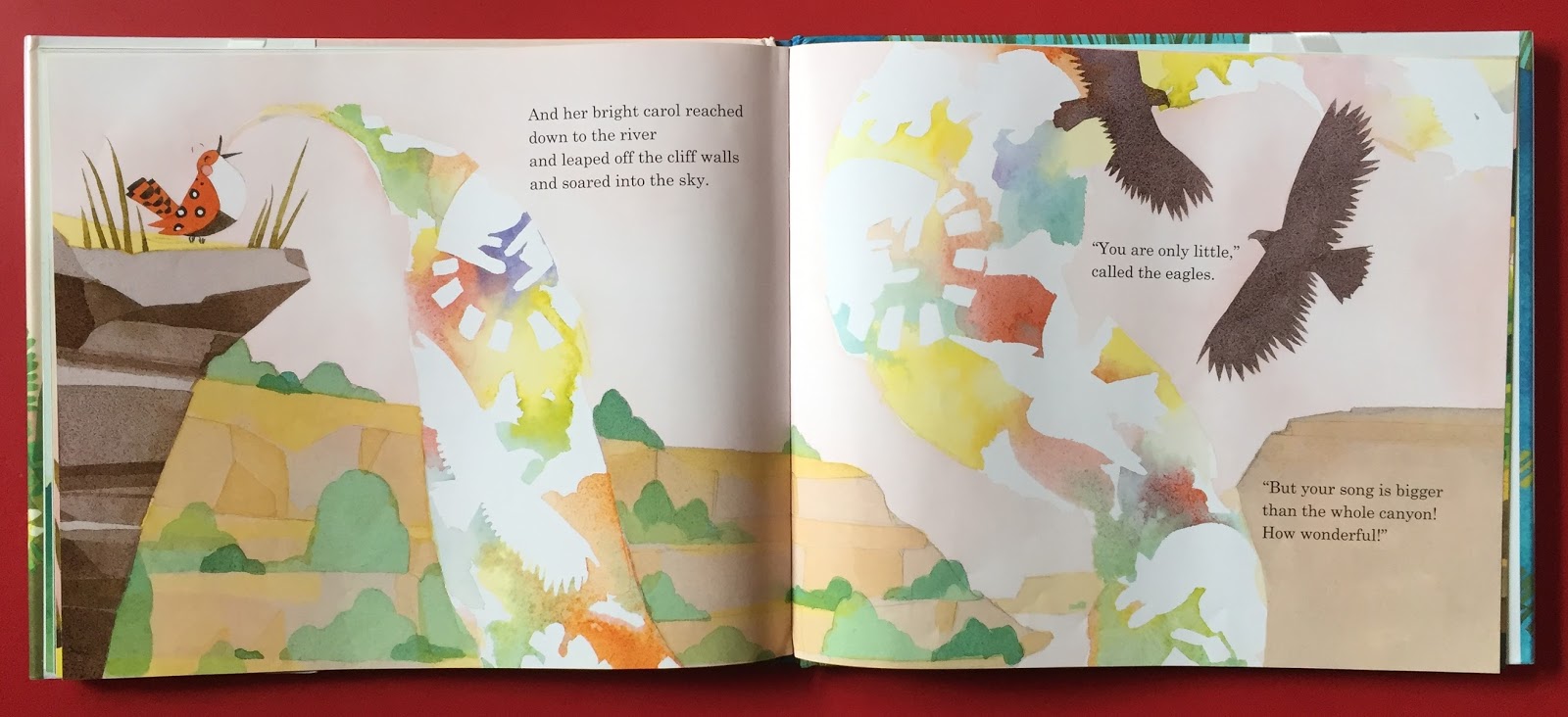
Next she is invited to soar with eagles and then asks, “What can I do that’s wonderful?” “Just then, “the sun painted the whole canyon pink.” 
Baby Wren is compelled to sit still.
The beauty of nature pushes on her throat until “with all her tiny might,” 
Baby Wren sings a “bright carol” that is a song of her purpose and gratitude. Here it is in part and then in total so you can read her meaning:
Afterwards, her singing is affirmed by the eagles: “…your song is bigger than the whole canyon. How wonderful!” 
And the world was filled with even more wonderfulness thanks to a grateful Baby Wren.
Hanna’s Comments: This secular book is all about a sacred act - singing praise to God. It is with a grateful and full heart that Baby Wren thanks her Maker for the splendor of her world. That is worship! Here you have a simple lesson about worship that is easily understood and relatable. Besides using this book to teach about praise and worship, consider playing with the two meanings of the word wonder. Both meanings are prominent in this story. Find scriptures that use this word and have your audience decipher the meaning. You might even want to distinguish it from the word wander which is also a concept in the Bible (think of the magi or the Israelites). And wandering can be a spiritual practice. Additionally, teach the concept of affirmation as beautifully demonstrated by the eagles in this story and encourage your children to practice it with one another. Tie this word to the concept of having gifts and offering them to God. At first Baby Wren is jealous of the other animals' abilities, but once she discovers and offers her gift, she is truly satisfied. Baby Wren is quite tiny in some of the illustrations so have young audiences locate her on each double-page spread.
Original Publisher & Date: Zonderkidz, 2016
Age & Grade Appropriateness: 4 and up, Pre and up
Formats other than Book: Tablet
Scripture Connections: There are many Bible verses and stories about praise and thanksgiving such as Hannah and Mary’s songs or the verses that start Psalm 100, 147, and 150.
Idea(s) for Application: Read this book to a group of children in a lesson on praise as an example of worship. If you are doing a PBT lesson at a private or home school, also use this book to teach a vocabulary lesson as described above.